
Adistemia
Fall, 1899
Species Guides
1- Adistemia watsoni(Household Fungus Beetle)
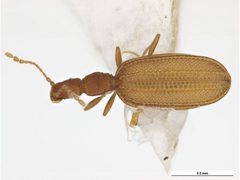
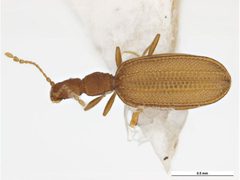
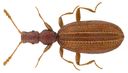
Adistemia is a of minute brown scavenger beetles in the Latridiidae, established by Fall in 1899. The genus contains at least twelve described distributed across Europe, the Americas, and other regions. At least one species, A. watsoni, is a documented stored product pest that feeds on fungal conidia. The genus is part of the diverse Latridiidae family, commonly known as plaster beetles or minute brown scavenger beetles, which are generally associated with moist, moldy environments.
Pronunciation
How to pronounce Adistemia: //ˌædɪˈstiːmiə//
These audio files are automatically generated. While they are not always 100% accurate, they are a good starting point.
Identification
Members of Adistemia can be distinguished from other Latridiidae by a combination of antennal structure, pronotal shape, and elytral sculpturing; however, -level identification requires examination of fine morphological details such as the degree of elytral convexity, presence and arrangement of setae, and specific patterns of carination. The genus is characterized by small body size typical of the (generally under 3 mm), with species differing in the prominence of elytral keels and patterns. Detailed keys to species are available in specialized taxonomic literature, particularly Dajoz's revisions from the 1960s–1970s.
Images
Habitat
varies by . Adistemia watsoni has been documented in stored product environments, specifically on stored plums and corn where mold growth occurs. Other species have been collected in association with leaf litter, decaying vegetation, and other moist microhabitats where fungal growth is present, consistent with the general of Latridiidae. The Chilean species A. convexa has been recorded from unspecified terrestrial habitats in Chile.
Distribution
Documented from Europe (Denmark, Norway, Sweden, Greece), the Americas (Chile, with A. chilenisi and A. convexa described from Chile; A. rileyi described from the United States), and likely other regions given the distribution patterns of many Latridiidae. GBIF records confirm presence in Denmark, Norway, and Sweden. The Greek record of A. watsoni represents a new country record for that .
Diet
Adistemia watsoni has been observed feeding on conidia of Penicillium developing on stored plums and corn. Other presumably feed on fungal spores and , consistent with the mycophagous diet typical of Latridiidae, though direct observations are lacking for most species.
Host Associations
- Penicillium - food sourceA. watsoni feeds on conidia of Penicillium developing on stored plums and corn
Ecological Role
As mycophagous beetles, members of this likely contribute to nutrient cycling by consuming fungal material in decaying organic matter. In stored product environments, A. watsoni may serve as an indicator of mold .
Human Relevance
Adistemia watsoni is recognized as a stored product pest, with documented presence in stored plums and corn. Its occurrence signals fungal of stored food products. No other in the are documented as economically significant pests.
Similar Taxa
- LatridiusBoth belong to Latridiidae and share small size and mycophagous habits; Adistemia is distinguished by specific antennal and pronotal characters detailed in taxonomic revisions
- EnicmusAnother of minute brown scavenger beetles with overlapping size range and preferences; separation requires examination of mouthpart structure and elytral microsculpture
More Details
Taxonomic History
The was extensively revised by Dajoz, who described the majority of known between 1960 and 1974. Several species were originally described in other genera and later transferred to Adistemia.
Identification Resources
Accurate identification to requires consultation of Dajoz's original descriptions and subsequent taxonomic revisions; no comprehensive modern key to all species is readily available in English.