
Euxestidae
Grouvelle, 1908
Genus Guides
2Euxestidae is a small of beetles in the superfamily Coccinelloidea, containing approximately 70 extant across 10 . Formerly treated as a of Cerylonidae, they were elevated to family status based on morphological and phylogenetic evidence. Members are primarily tropical and subtropical in distribution, with most species occurring in the Afro-Eurasian region. They inhabit concealed microhabitats including decomposing wood, leaf litter, and the nests of social insects.
Pronunciation
How to pronounce Euxestidae: /juːksˈɛstɪdiː/
These audio files are automatically generated. While they are not always 100% accurate, they are a good starting point.
Identification
Distinguished from related in Coccinelloidea by combinations of antennal structure, tarsal formula, and genitalic characters. Separation from Cerylonidae requires examination of male genitalia and detailed mouthpart . The polished, compact body form is shared with several related families, so dissection or high-magnification examination is typically necessary for definitive identification. Euxestus and Hypodacne are the most frequently encountered in collections.
Images
Appearance
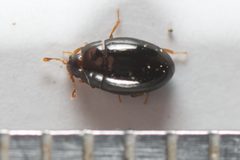
Beetles with a well-polished, often or shiny surface. Body form is generally compact and somewhat flattened. are typically short to moderately long with a weak to moderate club. The are smooth and cover the completely. Overall size is small, consistent with other coccinelloidean . Specific coloration varies by but tends toward dark brown to black tones.
Habitat
Found in moist, concealed microhabitats: decomposing wood, leaf litter, and compacted organic debris. Several occur within nests and in the fungus gardens of , indicating a capacity for of or to social insect environments. These provide consistent humidity and access to fungal food resources.
Distribution
Primarily distributed across tropical and subtropical regions of Afro-Eurasia. The shows a strong Old World , with limited representation in the Neotropics and Nearctic. Records extend from West Africa through Southeast Asia to the Pacific islands, with highest diversity in equatorial regions.
Diet
All are presumed mycophagous, feeding on fungal and spores. This dietary specialization is inferred from associations and mouthpart , though direct feeding observations are limited.
Host Associations
- termites - commensal or Some found in fungus gardens
- ants - commensal or Some recorded from nests
Behavior
Little documented; appears to be slow-moving and cryptic, consistent with concealed preferences. Association with social insect nests suggests some of colony conditions, though the nature of these relationships (commensalism, inquilinism, or incidental presence) remains poorly characterized.
Ecological Role
Contributes to decomposition processes in forest through mycophagy. Within fungus gardens, may function as adjunct decomposers or incidental consumers of cultivated fungi, though ecological impact is likely minor given small sizes.
Human Relevance
No documented economic importance. Occasionally encountered in forest entomology surveys and diversity studies. Not known to be pests or beneficial in agricultural or forestry contexts.
Similar Taxa
- CerylonidaeFormerly included within Cerylonidae; separation requires detailed morphological examination of mouthparts, , and male genitalia. Both share compact, polished body forms and mycophagous habits.
- BothrideridaeAnother in Coccinelloidea with similar body form; distinguished by different antennal structure and lack of association with fungus gardens.
- DiscolomatidaeRelated with polished appearance; differs in tarsal structure and preferences, typically not associated with social insect nests.
More Details
Taxonomic History
Elevated from status within Cerylonidae to rank based on phylogenetic studies of Coccinelloidea. This reclassification reflects improved understanding of relationships among the 'cerylonid series' of families.
Collection Challenges
Specimens are rarely collected in large numbers due to concealed preferences. Specialized extraction methods (Winkler funnels, ) from leaf litter and wood are most effective. Social insect nest dissections have yielded some of the most significant material.