
Bothrideridae
Erichson, 1845
cocoon-forming beetles, dry bark beetles
Tribe Guides
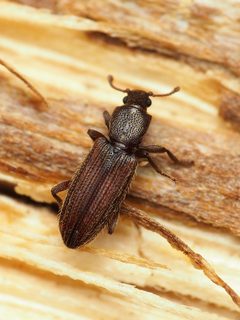
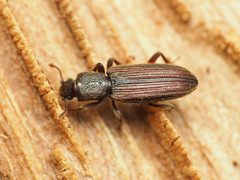
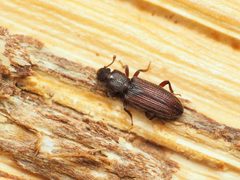
2is a of small to medium-sized beetles in the superfamily Coccinelloidea, commonly known as cocoon-forming beetles or dry bark beetles. Members are characterized by elongated, cylindrical to somewhat flattened bodies and are primarily found under tree bark in woodland . The family has undergone significant taxonomic revision, with former Teredinae, Xylariophilinae, and Anommatinae now placed in the separate family Teredidae. Bothrideridae has a worldwide distribution with greatest diversity in the Old World tropics. The family is notable for its ectoparasitoid larvae, which attack other wood-boring insects including cerambycid beetles, wood wasps, and carpenter bees. Several , particularly in the Dastarcus, are important biocontrol agents used commercially to manage forest pests such as the Japanese pine sawyer (Monochamus alternatus), a of .
Pronunciation
How to pronounce Bothrideridae: /bɒθˈraɪdəˌdaɪ/
These audio files are automatically generated. While they are not always 100% accurate, they are a good starting point.
Identification
can be distinguished from the superficially similar Teredidae (formerly included as ) by differences in mouthpart structure and larval . are separated from other Coccinelloidea by the combination of elongated body form, clubbed with 9–11 segments, and under bark. The family was historically confused with but is now recognized as unrelated. -level identification requires examination of genitalia and detailed morphological features; regional keys are available for North American fauna. The Dastarcus is distinguished by its large size relative to other bothriderids and its role as an ectoparasitoid of cerambycids.
Images
Habitat
Primarily found in woodland under the bark of dead or dying trees. inhabit the subcortical zone of various tree . Some species occupy subterranean habitats. The shows association with wood-boring insect in forest .
Distribution
Worldwide distribution with majority of native to the Old World tropics. Present in North America, Central America, South America, Europe, Asia, Africa, and Australia. Documented from England (Anommatus reitteri), Myanmar (fossil Alveoderes in mid-Cretaceous amber), and across East Asia including China, Korea, and Japan for economically important species such as Dastarcus helophoroides.
Diet
Larvae are ectoparasitoids of other insects, specifically attacking larvae and pupae of wood-boring beetles (Cerambycidae), wood wasps (Siricidae), and carpenter bees (Xylocopidae and related Apidae). feeding habits are poorly documented but likely involve subcortical microflora or -associated materials; some accept artificial diets in laboratory rearing.
Host Associations
- Cerambycidae (longhorn beetles) - larval ectoparasitoidPrimary ; includes Monochamus alternatus, Anoplophora glabripennis, Anoplophora chinensis, Massicus raddei, Batocera horsfieldi, Apriona germari, Apriona swainsoni
- Siricidae (wood wasps) - larval ectoparasitoidDocumented group
- Apidae (carpenter bees) - larval ectoparasitoidSpecifically Xylocopa appendiculata and related large carpenter bees
- Curculionidae (weevils) - larval ectoparasitoidMetamasius spinolae (nopal weevil) parasitized by Bothrideres cactophagi
Life Cycle
Complete with , larval, pupal, and stages. Eggs are laid near entrance holes or -extrusion holes. First instar larvae possess well-developed pectoral feet for active host foraging that degenerate after successful . Larvae feed externally as ectoparasitoids on host larvae or pupae. Developmental duration varies with temperature and host : egg stage approximately 12.7 days at 21°C, larval period 8–12 days, pupal/cocoon period 25–37 days. Multiple larvae may share a single host, with density-dependent effects on development time and adult . Adults are long-lived, with lifespans of 3–6 years reported for Dastarcus helophoroides. Two per year occur in wild of some .
Behavior
are primarily and positively phototactic. Females locate using olfactory cues, with sensitive chemosensory systems involving odorant binding proteins, chemosensory proteins, and odorant receptors. Visual cues also influence oviposition site selection; females can learn to associate substrate colors with oviposition sites. Copulation duration is highly plastic, responding to body size, mating history, kinship, sex ratio, mating sequence, feeding status, temperature, , and time of day. Inbred pairs and food-deprived couples exhibit longer copulations. occurs among larvae sharing hosts, with at low densities shifting to contest competition at higher densities.
Ecological Role
function as specialized natural enemies of wood-boring insects in forest . As ectoparasitoids, they regulate of primary wood decomposers and forest pests. Several are commercially mass-reared and released as biocontrol agents in programs, particularly for suppression of cerambycid of forest . The trade-off between numbers and body size in response to availability may stabilize . Their association with subcortical contributes to biodiversity in dead wood .
Human Relevance
Economically important as biocontrol agents for forest pest management. Dastarcus helophoroides is commercially produced and released to control Monochamus alternatus, the of (Bursaphelenchus xylophilus), in East Asian countries. Research focuses on optimizing mass-rearing techniques, including optimal larval (approximately 6 larvae per for maximum ), artificial diets, and storage methods. Venom proteins from D. helophoroides larvae show potential for development of environmentally safe pest control chemistries. The is of minor direct agricultural significance otherwise.
Similar Taxa
- TeredidaeFormerly treated as (Teredinae, Xylariophilinae, Anommatinae) within ; now recognized as separate based on morphological and molecular evidence. Distinguished by differences in mouthpart structure and larval .
- ColydiidaeHistorically confused with in older literature; now considered unrelated. typically exhibit more flattened body forms and different ecological associations.
More Details
Taxonomic History
The underwent major revision with the elevation of former Teredinae, Xylariophilinae, and Anommatinae to family rank as Teredidae. The remaining now comprises primarily the subfamily Bothriderinae. Fossil evidence includes Alveoderes from mid-Cretaceous Burmese amber (early Cenomanian) and Pseudobothrideres from Eocene European deposits, indicating ancient diversification of the lineage.
Genetic Research
Molecular studies have characterized olfactory in Dastarcus helophoroides, identifying odorant binding proteins, chemosensory proteins, odorant receptors, ionotropic receptors, receptors, and proteins with stage- and tissue-specific expression patterns. Methuselah-like genes associated with longevity, stress resistance, and have been identified, correlating with the extended lifespan of 3–6 years.
Commercial Production
Mass-rearing protocols utilize substitute such as Zophobas morio (Tenebrionidae) pupae. Optimal rearing of 6 larvae per host balances against production . Adults can be stored at low temperatures (5°C) for extended periods with minimal mortality, facilitating commercial distribution.
Sources and further reading
- BugGuide
- Wikipedia
- GBIF taxonomy match
- iNaturalist taxon
- NCBI Taxonomy
- Catalogue of Life
- Graphisurus triangulifer in Missouri | Beetles In The Bush
- Bibliography | Beetles In The Bush
- Factors Influencing Copulation Duration in Dastarcus helophoroides (Fairmaire) (Coleoptera: Bothrideridae)
- Anommatus reitteri (Coleoptera: Bothrideridae) new to the British fauna
- Density-Dependent Growth and Fitness in Dastarcus helophoroides (Coleoptera: Bothrideridae)
- THE GENUS TEREDOLAEMUS SHARP (COLEOPTERA: BOTHRIDERIDAE) IN AUSTRALIA
- Bothrideres cactophagi schwarz (coleoptera: bothrideridae), parasitoide del picudo del nopal en México
- Identification, Characterization and Expression of Methuselah-Like Genes in Dastarcus helophoroides (Coleoptera: Bothrideridae)
- The Bothrideridae and Colydiidae of America North of Mexico (Coleoptera: Clavicornia and Heteromera)
- Genetic Population Structure of Dastarcus helophoroides (Coleoptera: Bothrideridae) From Different Long-Horned Beetle Hosts Based on Complete Sequences of Mitochondrial COI
- Effects of host stage and number of feeding larvae on parasitism success and fitness in the coleopteran parasitoid, Dastarcus longulus Sharp (Coleoptera: Bothrideridae)
- Parasitism and olfactory responses of Dastarcus helophoroides (Coleoptera: Bothrideridae) to different Cerambycid hosts
- Influence of visual cues on oviposition site searching and learning behavior in the parasitic beetle Dastarcus helophoroides (Fairmaire) (Coleoptera: Bothrideridae)
- A method for rearing larvae of the parasitoid beetle Dastarcus longulus (Coleoptera: Bothrideridae) using Zophobas atratus (Coleoptera: Tenebrionidae) pupae
- Identification of Putative Venom Proteins from Dastarcus helophoroides (Coleoptera: Bothrideridae) Larvae, an Ectoparasitoid of Longhorned Beetles (Coleoptera: Cerambycidae)
- A new extinct species of the genus Pseudobothrideres Grouvelle (Coleoptera: Cucujiformia: Bothrideridae) – an addition to ectoparasitoid diversity from the Eocene of Europe
- Temporal and Spatial Expression of Parasitism-Related Olfactory Genes in Larvae of the Ectoparasitoid Dastarcus helophoroides (Coleoptera: Bothrideridae)
- Efficiency Enhancement Technology of Dastarcus helophoroides (Coleoptera: Bothrideridae) for Controlling Monochamus alternatus (Coleoptera: Cerambycidae): Drilling Optimization and Biological Collaboration.
- Determination of Larval Instars of Dastarcus helophoroides (Coleoptera: Bothrideridae) Using Head Capsule Width Frequency Distribution.