
Teredidae
Seidlitz, 1888
Genus Guides
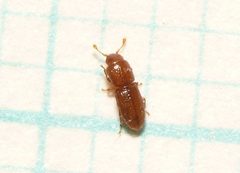
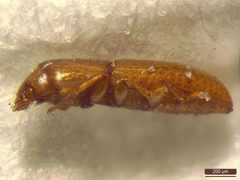
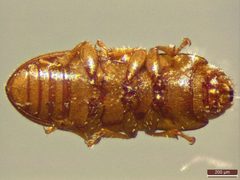
3Teredidae is a of small beetles in the superfamily Coccinelloidea, containing approximately 160 in 10 . The family has a distribution excluding South America and Antarctica. Teredids are typically found in concealed microhabitats such as under bark, in leaf litter, and especially within the galleries of wood-boring beetles. The family was historically treated as a of Bothrideridae but is now recognized as distinct. Fossil records extend to the mid-Cretaceous with Delteredolaemus from Burmese amber.
Pronunciation
How to pronounce Teredidae: //tɛˈriːdɪdiː//
These audio files are automatically generated. While they are not always 100% accurate, they are a good starting point.
Identification
Teredidae can be distinguished from related in Coccinelloidea by their cylindrical, parallel-sided body form and association with wood-boring galleries. The combination of small size (3–4 mm), dark coloration, setose , and under bark or in beetle tunnels aids recognition. Teredus are distinguished from by details of elytral setation, punctation , and antennal coloration. The serrate elytral margins and specific setal patterns serve as diagnostic characters for species-level identification.
Images
Habitat
Found under bark, in leaf litter, and within galleries of wood-boring beetles. In mountainous regions, collected from bamboo forests at elevations of 1299–2017 m. Specific collections from Bashania fargesii and Fargesia qinlingensis bamboo stands.
Distribution
distribution excluding South America and Antarctica. Recorded from Europe, North Africa, East Asia (China: Shaanxi Province, Qinling Mountains), and other regions worldwide. The Teredus historically known only from Europe and North Africa, now extended to East Asia with discovery of T. chinensis.
Seasonality
active June through September in surveyed Chinese . Seasonal activity patterns likely vary by region and .
Diet
Proposed to be mycophagous (fungivorous), feeding on fungi within wood-boring galleries.
Host Associations
- Ptinidae (Anobiinae) - gallery associationwood-boring beetles whose tunnels inhabited by teredids
- Curculionidae (Platypodinae) - gallery associationwood-boring beetles whose tunnels inhabited by teredids
- Curculionidae (Scolytinae) - gallery associationwood-boring beetles whose tunnels inhabited by teredids
- Scolytinae (Xylosandrus germanus) - gallery associationspecific wood-boring
- Scolytinae (Xylosandrus amputatus) - gallery associationspecific wood-boring
- Scolytinae (Xylosandrus borealis) - gallery associationspecific wood-boring
- Scolytinae (Scolytoplatypus cf. blandfordi) - gallery associationspecific wood-boring
- Scolytinae (Scolytoplatypus mikado) - gallery associationspecific wood-boring
- Bostrichidae (Dinoderus japonicus) - gallery associationspecific wood-boring
Life Cycle
and larvae inhabit the same microhabitats under bark and in wood-boring galleries. Specific developmental stages and duration not described in detail.
Behavior
Specimens have been collected using blue and yellow pan traps and ground traps. Inhabits concealed spaces, likely moving through galleries of wood-boring beetles.
Ecological Role
Associated with wood-boring beetles in forest , likely functioning as mycophagous consumers of fungi growing in galleries. May serve as indicators of beetle gallery presence in forest health assessments.
Human Relevance
No direct economic importance documented. Presence may indicate wood-boring activity in timber and forest management contexts.
Similar Taxa
- BothrideridaeHistorically included Teredidae as a ; both share cylindrical body form and association with wood-boring beetles, but differ in specific morphological details and current taxonomic treatment
- CerylonidaeRelated in Coccinelloidea with similar small size and concealed preferences; differs in body form and specific ecological associations
More Details
Fossil Record
The oldest known teredid is Delteredolaemus from mid-Cretaceous Burmese amber (Myanmar). A of Teredolaemus is known from Eocene Baltic amber.
Taxonomic History
Teredidae was elevated from status within Bothrideridae to rank, reflecting distinct morphological and ecological characteristics.
Collection Methods
Blue and yellow pan traps have proven effective for collecting flying , suggesting some activity despite concealed larval .