
Microweisea misella
(LeConte, 1878)
Micro Lady Beetle
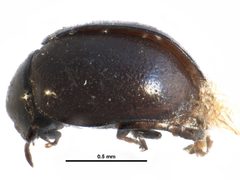
Microweisea misella is a minute lady beetle (Coccinellidae) native to North America. measure only 1–1.5 mm in length and are darkly colored. The is a specialized of armored scale insects (Diaspididae), particularly on blueberry and other shrubs and trees. It has been documented across southern Canada and much of the United States, and is associated with urban and agricultural where occur.
Pronunciation
How to pronounce Microweisea misella: /ˌmaɪkroʊˈwaɪziə maɪˈsɛlə/
These audio files are automatically generated. While they are not always 100% accurate, they are a good starting point.
Identification
Distinguished from other Coccinellidae by its minute size (1–1.5 mm) and uniformly dark coloration. Most other North American lady beetles are larger and/or display contrasting spot patterns. The Microweisea contains similarly tiny ; M. misella may require microscopic examination or association with scale insects for definitive identification.
Images
Habitat
Occurs in supporting its insect prey, including blueberry plantings, shrubs, and trees. Has been observed in urban environments where occur on red maple and other urban trees.
Distribution
Native to North America. Documented throughout southern Canada (Alberta, British Columbia, Manitoba) and much of the United States. GBIF records confirm presence across North America.
Diet
of armored scale insects ( Diaspididae). Documented feeding on gloomy (Melanaspis tenebricosa) and other Diaspididae on blueberry, shrubs, and trees. Scale insects serve as direct prey; the may also be attracted to scale honeydew and associated prey .
Host Associations
- Diaspididae - preyarmored scale insects
- Melanaspis tenebricosa - preygloomy on urban red maple
- Vaccinium - blueberry plantings
Ecological Role
Acts as a natural enemy of armored scale insects in urban and agricultural . Contributes to of on trees and shrubs. Its presence in scale-infested trees may indicate functional natural enemy that support pest suppression in nearby plants.
Human Relevance
Beneficial insect in . Potential agent for on urban trees and blueberry crops. Research suggests that conserving -infested trees can support of this and other natural enemies, providing associational resistance to pests in adjacent landscape plants.
Similar Taxa
- Other CoccinellidaeMost other lady beetles are larger (>2 mm) and often display contrasting color patterns (red, orange, or yellow with black spots). Microweisea misella is distinguished by its minute size and dark, unpatterned coloration.
- Other Microweisea speciesCongeneric share similar minute size and dark coloration; may require microscopic examination or geographic/ associations for separation.
More Details
Research Context
Featured in studies of natural enemy in urban landscapes. Research by Wilson and Frank (NC State University) documented Microweisea sp. as part of communities attracted to -infested urban trees, contributing to broader understanding of how urban tree pests can support services in nearby plants.