
Hyperaspis rotunda
Casey, 1899
Hyperaspis rotunda is a small lady beetle in the Coccinellidae, first described by Casey in 1899. It is native to North America, with confirmed records from Texas. The species belongs to a whose members are known as specialized of scale insects.
Pronunciation
How to pronounce Hyperaspis rotunda: /haɪˈpɪərəspɪs roʊˈtʌndə/
These audio files are automatically generated. While they are not always 100% accurate, they are a good starting point.
Identification
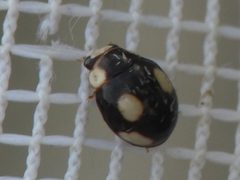
Distinguished from other Hyperaspis by the specific pattern of two yellow spots on each and the lateral yellow marking on the black pronotum. The small size (under 3 mm) and compact body shape are consistent with the . Accurate identification to species level may require examination of genitalic characters or comparison with .
Images
Appearance
measure 2.20–2.80 mm in length. The pronotum is black with a lateral yellow area. Each bears two yellow spots.
Distribution
Recorded from North America, specifically from Texas. Distribution details beyond this single state record are not documented in available sources.
Similar Taxa
- Other Hyperaspis speciesShare the same and general body plan of small, often spotted lady beetles. Many Hyperaspis have similar color patterns of black with yellow or red markings, requiring careful examination of spot number, position, and pronotal pattern for separation.
More Details
Taxonomic note
The specific epithet 'rotunda' refers to the rounded body shape characteristic of this . The species was described by Thomas Lincoln Casey Jr., a prolific American coleopterist, in 1899.
Data limitations
This is poorly represented in collections and literature. Only five observations are recorded in iNaturalist, and detailed biological information appears to be lacking from published sources.
Sources and further reading
- BugGuide
- Wikipedia
- GBIF taxonomy match
- iNaturalist taxon
- Waxy lady beetles come to the rescue of pest-plagued crapemyrtles, Hyperaspis spp. — Bug of the Week
- To Grow a Right-Sized Bee, Give It a Right-Sized Nest
- Alfalfa Leafcutting Bees Like Nests That Face North, Study Shows
- Bug Eric: August 2023
- Beyond the Honey Bee: How Pesticides Affect Solitary Bees
- An Alfalfa Leafcutting Bee's First Meal is a Big Deal