
Hyperaspis quadrioculata
(Motschulsky, 1845)
Four-eyed Lady Beetle, Four-eyed Sigil Lady Beetle
Hyperaspis quadrioculata, commonly known as the four-eyed lady beetle, is a small predatory in the Coccinellidae. measure 2.7–4.0 mm and display variable color patterns on their . The is native to North America, with confirmed records from central and southern California. Like other members of the Hyperaspis, it is a specialized of scale insects.
Pronunciation
How to pronounce Hyperaspis quadrioculata: //ˌhaɪpəˈræspɪs ˌkwɒdriˌɒkjəˈleɪtə//
These audio files are automatically generated. While they are not always 100% accurate, they are a good starting point.
Identification
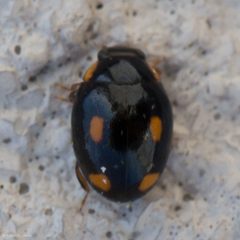
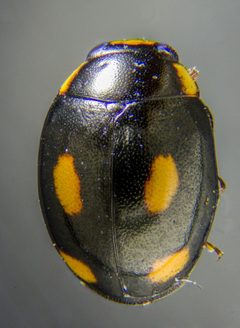
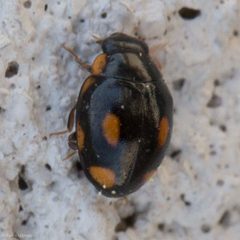
distinguished from other lady beetles by small size (under 4 mm), shiny black with four red spots, and association with -infested plants. Larvae are easily confused with mealybugs or other scale insects due to their white, waxy coating; however, they can be distinguished by their more rapid movement when disturbed—mealybugs remain sedentary while Hyperaspis larvae amble away quickly. The waxy covering also serves as protective camouflage among scale insect colonies.
Images
Appearance
are small beetles, 2.70–4.0 mm in length. The bear a variable color pattern. Adults are typically shiny black with red spots on the wing covers—four spots in this , corresponding to the specific epithet "quadrioculata" (four-eyed). Some individuals or related species may display yellowish spots or stripes. Larvae are covered in a dense, white, waxy secretion produced by glands along the sides of the body, giving them a mealybug-like appearance.
Habitat
Associated with trees and shrubs infested with scale insects, including crapemyrtles and magnolias. Found in urban, suburban, and natural settings where occur.
Distribution
North America; recorded from central and southern California. The Hyperaspis has broader distribution across North America, but this appears restricted to western regions.
Seasonality
active in spring and summer. Larvae present through summer and early autumn. Adults overwinter in protected locations beneath bark or in leaf litter, departing -infested trees by early December. and return to trees occurs the following spring.
Diet
Specialized of scale insects (Coccidae) and their . Larvae consume and eggs deposited in waxy egg sacs. continue on scales. A single larva may consume several thousand immature scale insects during development.
Host Associations
- Crapemyrtle bark scale - preyAcanthococcus lagerstroemiae; major target of
- Tuliptree scale - preyToumeyella liriodendri; documented prey on magnolia
Life Cycle
laid on or near -infested trees in spring. Larvae hatch and develop through several instars, feeding on scale insects while concealed beneath waxy coating. occurs in autumn. emerge, feed briefly, then disperse to sites. or partially depending on climate.
Behavior
Larvae produce waxy secretions from lateral glands as a defensive against ants and other . This chemical camouflage allows them to forage within -tended colonies. Both larvae and are active hunters, seeking out scale sacs and piercing them to consume contents. Adults and larvae show rapid escape response when disturbed.
Ecological Role
Important agent of insect pests. Helps regulate of economically significant scales including . Larval wax production represents an evolutionary counteradaptation to -plant-hemipteran mutualisms, allowing within protected scale colonies.
Human Relevance
Beneficial insect for horticulture and urban forestry. Provides natural suppression of crapemyrtle bark scale, tuliptree scale, and other landscape pests. Frequently misidentified as a pest (mealybug) and inadvertently killed by applications. Conservation recommended through reduced use and recognition of waxy larvae as , not pests.
Similar Taxa
- Mealybugs (Pseudococcidae)Larvae closely resemble mealybugs due to white waxy coating; distinguished by faster movement and predatory
- Other Hyperaspis speciesShare black-and-red spotted pattern and waxy larvae; H. quadrioculata specifically has four spots and western distribution
- Multicolored Asian Lady Beetle (Harmonia axyridis)Similar lady beetle membership but much larger (5–8 mm), highly variable color patterns, and not specialized on
Misconceptions
Larvae are commonly mistaken for mealybugs or other plant pests and killed by applications. The waxy coating is protective, not indicative of pest status. beetles may also be overlooked due to small size.
More Details
Conservation Status
Not formally assessed; appears secure but vulnerable to misuse due to misidentification of larvae
Etymology
Specific epithet quadrioculata refers to the four -like spots on the (from Latin quadri- "four" and oculatus "eyed")