
Brachiacantha ursina
(Fabricius, 1787)
ursine spurleg lady beetle, orange-spotted lady beetle
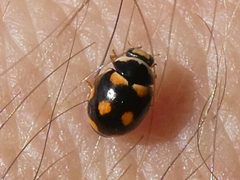
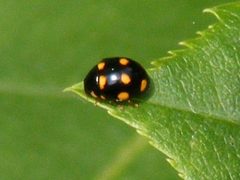
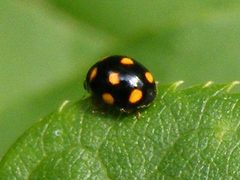
A small North American lady beetle, 3–4 mm in length, recognized by the male's black pronotum with yellow margin and five yellow spots on each . The has been recorded from Nova Scotia to South Carolina, west to Manitoba and Iowa. It belongs to the Brachiacantha, which is characterized by modified hind legs in males.
Pronunciation
How to pronounce Brachiacantha ursina: /ˌbrækiəˈkænθə ˈɜrˌsaɪnə/
These audio files are automatically generated. While they are not always 100% accurate, they are a good starting point.
Identification
Distinguished from other Coccinellidae by the combination of small size (3–4 mm), five yellow spots per , and in males, the black pronotum with yellow margin and anterolateral angle. The spurred hind legs of males are diagnostic for the Brachiacantha. Similar spot patterns occur in other lady beetles, but the specific pronotum pattern and small size help differentiate this .
Images
Appearance
measure 3–4 mm in length. Males have a black pronotum with a yellow margin and yellow anterolateral angle. Each bears five yellow spots. The name 'Brachiacantha' refers to the spurred hind legs found in males, a distinctive structural trait of the genus.
Distribution
Eastern and central North America: recorded from Nova Scotia to South Carolina, west to Manitoba and Iowa. Specific Canadian provinces with records include Alberta, Manitoba, and New Brunswick.
Similar Taxa
- Other Brachiacantha speciesShare the -characteristic spurred male hind legs and similar small size; require examination of spot patterns and pronotum coloration for separation
- Other Coccinellidae with five-spotted elytraSimilar spot patterns occur in such as Hippodamia and Coccinella, but these are generally larger and lack the specific pronotum pattern and male leg modifications of Brachiacantha
More Details
Taxonomic history
Originally described as Coccinella ursina by Fabricius in 1787, later transferred to Brachiacantha. The Brachiacantha is distinguished within Coccinellidae by the presence of spurs on the hind legs of males.