
Paranaemia
Casey, 1899
broad-striped lady beetle
Species Guides
1- Paranaemia vittigera(Broad-striped Lady Beetle)
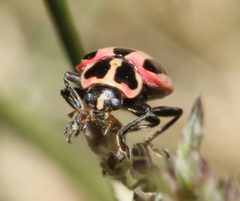
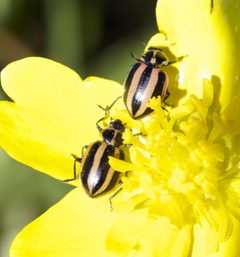
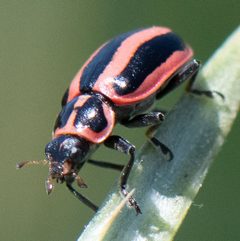
Paranaemia is a of lady beetles ( Coccinellidae) containing one described , P. vittigera, commonly known as the broad-striped lady beetle. The genus was established in 1899 based on distinctive claw , separating it from the related genus Hippodamia. Native to western North America, this is recognized by its striped rather than the spotted pattern typical of many lady beetles.
Pronunciation
How to pronounce Paranaemia: /ˌpærəˈniːmiə/
These audio files are automatically generated. While they are not always 100% accurate, they are a good starting point.
Identification
Distinguished from similar Hippodamia and Macronaemia by its margined pronotal base and basally toothed claws (versus bifid claws in Hippodamia). The three black vittae on yellow to pink can cause superficial confusion with striped Hippodamia , but the pronotal margin structure provides reliable separation.
Images
Appearance
are elongate and dorsoventrally flattened, measuring 4.5–6.6 mm in length. The range from yellow to pink with three distinct black longitudinal stripes (vittae). The is black, and the pronotum matches the elytral color with two large triangular black spots. The basally toothed claws are a key diagnostic feature not visible without magnification.
Habitat
Found in vegetation near riverbanks, streams, and wetlands, as well as meadows, grasslands, and agricultural field crops. Associated with flowering plants including California poppy (Eschscholzia californica).
Distribution
Native to western North America from Alberta to western Texas, west to British Columbia and California, and south to the Mexican states of Michoacán and Guanajuato. Introduced to Hawai'i.
Diet
, feeding on plant matter and soft-bodied insects including aphids. Observed to be less voracious and a slower forager compared to sympatric native (Hippodamia convergens, Cycloneda sanguinea) and the Harmonia axyridis.
Behavior
exhibit strong tendencies toward monospecific . Known to be parasitized by ( Mermithidae) and mites ( Coccipolipus).
Ecological Role
Functions as both a of soft-bodied insects and a consumer of plant material. Its relatively slow foraging may reduce competitive effectiveness against faster lady beetle in shared .
Human Relevance
Occasionally encountered in agricultural settings. Subject of citizen science documentation through platforms such as iNaturalist and the Lost Ladybug Project. Little targeted economic or biocontrol use documented.
Similar Taxa
- HippodamiaSimilar striped elytral patterns in some ; distinguished by bifid (split) claws versus basally toothed claws in Paranaemia, and unmargined pronotal base.
- MacronaemiaSimilar body form and coloration; separated by pronotal base and claw structure.
More Details
Taxonomic history
Originally described as Hippodamia vittigera by Mannerheim in 1843. Casey established the Paranaemia in 1899 based on claw . Molecular analysis using 5 nuclear genes and 1 mitochondrial gene subsequently supported this separation, placing Paranaemia in a distinct clade from Hippodamia.
Research gaps
Despite being native to California and well-represented in museum collections, biological information remains limited. Kimsey (UC Davis) noted in 2010 that 'little biological information' was available for this .