
Hippodamia moesta
LeConte, 1854
sorrowful lady beetle
Species Guides
2- Hippodamia moesta bowditchi(Bowditch's Lady Beetle)
- Hippodamia moesta moesta(Sorrowful Lady Beetle)
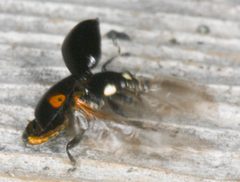
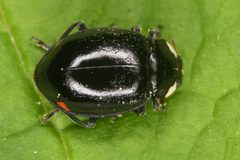
Hippodamia moesta, commonly known as the sorrowful lady beetle, is a of lady beetle in the Coccinellidae. It is native to western North America and is characterized by its predominantly black with a pale marginal spot and body length of 6–7.5 mm. The species includes three recognized with distinct geographic distributions.
Pronunciation
How to pronounce Hippodamia moesta: /hɪpoʊˈdeɪmiə ˈmɛstə/
These audio files are automatically generated. While they are not always 100% accurate, they are a good starting point.
Identification
Distinguished from other Hippodamia by the combination of black with a single pale spot on the margin and the relatively small body size (6–7.5 mm). The H. m. moesta, H. m. bowditchi, and H. m. politissima show geographic partitioning that may aid identification. Similar species with spotted patterns or all-black elytra without marginal spots should be compared.
Images
Appearance
measure 6–7.5 mm in length. The pronotum sometimes bears pale spots. The are normally black with a pale spot on the margin. No additional color pattern details are documented for this .
Distribution
Recorded from western North America: British Columbia, Washington, Oregon, California, Idaho, Montana, and Colorado. The three show partially overlapping ranges: H. m. bowditchi occurs in British Columbia, California, Colorado, Idaho, and Montana; H. m. moesta in British Columbia, California, Oregon, and Washington; H. m. politissima is restricted to California.
Similar Taxa
- Hippodamia convergensSimilar and general form, but H. convergens has prominent converging white markings on the pronotum and typically orange-red with black spots, unlike the black elytra with pale marginal spot of H. moesta
More Details
Subspecies
Three are recognized: Hippodamia moesta moesta LeConte, 1854; Hippodamia moesta bowditchi Johnson, 1910; and Hippodamia moesta politissima Casey, 1899. Each has a distinct geographic range within western North America.
Sources and further reading
- BugGuide
- Wikipedia
- GBIF taxonomy match
- iNaturalist taxon
- Birds, Bats or a Bloom? But No Splat! | Bug Squad
- Meloidae Holdings | Entomology Research Museum
- Researchers Share New Method for Detecting Insect Egg Predators
- Bacteria Can Aid Aphids Against Predation and Parasitism
- From Burglars to Bugs: Anti-Theft Dye Useful in Insect-Tracking Studies
- Hispanic Heritage Month: Publications Showcase