
Coccinella fulgida
Watson, 1954
Gleaming Lady Beetle
Coccinella fulgida is a small lady beetle in the Coccinellidae, described by Watson in 1954. measure 4.50–5.60 mm in length. The species is found in northern North America, with records from Alaska, British Columbia, Northwest Territories, and Quebec. It is among the less commonly documented members of the Coccinella.
Pronunciation
How to pronounce Coccinella fulgida: /kɔk.sɪˈnɛl.lə ˈfʊl.d͡ʒɪ.də/
These audio files are automatically generated. While they are not always 100% accurate, they are a good starting point.
Identification
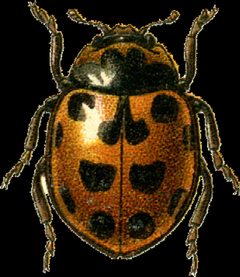
The combination of small body size (4.50–5.60 mm), black with two pale spots, black pronotal margin with pale spots, and the specific elytral spot pattern (subbasal plus spots) separates C. fulgida from other North American Coccinella . Coccinella septempunctata has seven spots on the and different pronotal markings. Coccinella transversoguttata has transverse elytral markings. Coccinella novemnotata has nine spots and a complete white pronotal collar. The small size and northern distribution also help distinguish this species.
Images
Appearance
are small, measuring 4.50–5.60 mm in length. The is black with two pale spots. The pronotum has a black margin with a small pale spot and a spot. Each bears a small subbasal spot and a spot. The overall coloration and spot pattern distinguish it from other Coccinella .
Distribution
Recorded from Alaska, British Columbia, Northwest Territories, and Quebec in northern North America. The appears restricted to high-latitude regions of the continent.
Similar Taxa
- Coccinella septempunctataSeven-spotted lady beetle has seven elytral spots and different pronotal pattern with white only at corners
- Coccinella novemnotataNine-spotted lady beetle is larger, has nine elytral spots, and complete white pronotal collar from corner to corner
- Coccinella transversoguttataTransverse lady beetle has connected spots forming horizontal bars on near pronotum
More Details
Taxonomic Note
Coccinella fulgida was described by Watson in 1954. It is one of the more recently described in the and among the least documented in terms of and . The specific epithet 'fulgida' refers to gleaming or shining appearance, though the source of this characteristic in the species is not detailed in available literature.
Data Limitations
This has only 4 observations on iNaturalist as of source date, indicating it is rarely encountered or underreported. Most aspects of its —including preferences, diet, seasonal activity, and full geographic range—remain undocumented in published sources.
Sources and further reading
- BugGuide
- Wikipedia
- GBIF taxonomy match
- iNaturalist taxon
- NCBI Taxonomy
- A Mural Like No Other | Bug Squad
- Deep Look's Award-Winning Aphid Video by Josh Cassidy--and a UC Davis Entomologist's Role | Bug Squad
- Bug Eric: A Flower Scarab, Euphoria fulgida
- Bug Eric: ID Tip: Seven-spotted or Nine-spotted Lady Beetle?
- Bug Eric: "Zombie Ladybugs"
- Tabloid Sensationalism Aside, Lady Bugs Are Still Fascinating