
Azya orbigera
Mulsant, 1850
globe-marked lady beetle
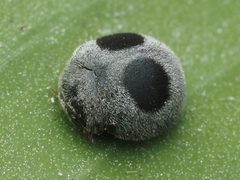
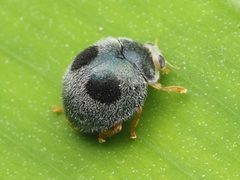
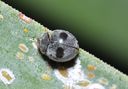
Azya orbigera, commonly known as the globe-marked lady beetle, is a small lady beetle in the Coccinellidae. It is distinguished by its unusual cobalt blue coloration and dense , which contrast sharply with the typical red-and-black pattern of most lady beetles. measure 2.90–4.25 mm in length and possess a yellow with greenish-black dorsum and a characteristic round discal spot on each . The species has a broad distribution across North America, Oceania, and South America, with two recognized .
Pronunciation
How to pronounce Azya orbigera: //ˈeɪziə ɔrˈbɪd͡ʒərə//
These audio files are automatically generated. While they are not always 100% accurate, they are a good starting point.
Identification
Distinguished from other lady beetles by its cobalt blue coloration and dense , unlike the smooth, glabrous appearance of typical red/orange/yellow and black lady beetles. The round discal spot on each and small size (under 5 mm) help separate it from similar . The combination of blue color, pubescence, and yellow is unique among North American Coccinellidae.
Images
Distribution
North America, Oceania, and South America; including Hawaii and the conterminous 48 United States
Similar Taxa
- Hylaeogena spp.Buprestidae beetles that mimic Azya as models; Azya serves as a color mimicry model for these unrelated beetles
- Typical Coccinellidae (e.g., Harmonia axyridis, Coccinella septempunctata)Distinguished by coloration: Azya orbigera is cobalt blue with dense versus the smooth, glabrous red/orange/yellow and black patterns of most lady beetles
More Details
Subspecies
Two are recognized: Azya orbigera ecuadorica Gordon, 1980 and Azya orbigera orbigera Mulsant, 1850 (nominate subspecies)
Mimicry relationships
According to entomologist Henry Hespenheide, Azya serve as models for beetles in the Hylaeogena ( Buprestidae), representing a case of color mimicry