
Phyllobrotica nigritarsis
Blatchley
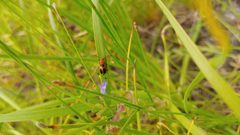
Phyllobrotica nigritarsis is a rare leaf beetle (Chrysomelidae) to the central United States. The was historically known from only four specimens collected in Missouri during the late 1800s until a small series was collected in 1987. It is an extreme , feeding exclusively on Scutellaria parvula (small skullcap), a member of the mint (Lamiaceae). Like other Phyllobrotica species, it inhabits wet bottomland rather than dry prairies.
Pronunciation
How to pronounce Phyllobrotica nigritarsis: //ˌfɪloʊˈbroʊtɪkə ˌnɪɡrɪˈtɑrsɪs//
These audio files are automatically generated. While they are not always 100% accurate, they are a good starting point.
Identification
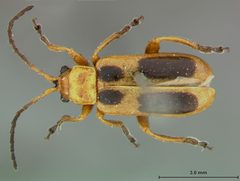
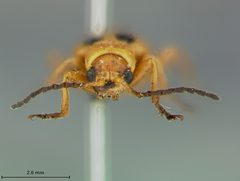
Phyllobrotica nigritarsis can be distinguished from other Phyllobrotica by its dark (black legs), which is the source of its specific epithet. The Phyllobrotica is characterized by small, compact leaf beetles with relatively broad, rounded . Species-level identification requires examination of genitalia and comparison with ; P. nigritarsis is most similar to P. lengi but differs in leg coloration and subtle body proportions. No field identification characters have been published for distinguishing P. nigritarsis from without specimen examination.
Images
Habitat
Wet bottomland , particularly in association with its plant Scutellaria parvula. The 1987 collection site in east-central Missouri was in a moist, low-lying area supporting of small skullcap.
Distribution
Known from Missouri, USA. Historical records from the late 1800s and a 1987 collection in east-central Missouri. The ' full range remains poorly documented due to its rarity and specialized requirements.
Diet
and larvae feed exclusively on Scutellaria parvula (small skullcap, Lamiaceae). This extreme specialization is characteristic of the Phyllobrotica.
Host Associations
- Scutellaria parvula - obligate and larval food plant; only confirmed
Ecological Role
Herbivore specializing on Scutellaria parvula. As a rare, -specific leaf beetle, it likely exerts minimal -level impact on its host plant but serves as an indicator of intact bottomland quality.
Human Relevance
Of interest to coleopterists and conservation biologists as one of Missouri's rarest beetles. The 1987 collection by Rev. James Sullivan provided critical new locality data and information. No economic or agricultural significance.
Similar Taxa
- Phyllobrotica lengiAlso rare in Missouri, historically confused due to similar size and preferences; distinguished by leg coloration (P. lengi lacks dark ) and genitalic differences
- Phyllobrotica circumdataAnother rare Missouri with similar Scutellaria association; distinguished by elytral pattern and body shape
- Phyllobrotica limbataMore common Missouri ; distinguished by broader distribution and association with Scutellaria ovata and S. lateriflora rather than S. parvula
More Details
Taxonomic history
First described by Blatchley. Remained virtually unknown in Missouri for nearly a century after initial collection. The 1987 rediscovery by Rev. James Sullivan on Scutellaria parvula in east-central Missouri doubled the known specimen count for the state and provided the first reliable record.
Conservation status
Considered one of Missouri's rarest beetles. No formal conservation status assigned, but extreme rarity, specialized requirements, and dependence on a single plant suggest vulnerability to habitat loss and wetland degradation.
Research significance
The Phyllobrotica has been used as a model system for studying between leaf beetles and plants in the mint (Farrell & Mitter 1990). P. nigritarsis, like most , demonstrates extreme host fidelity to a single Scutellaria .