
Sphaeroderma testaceum
(Fabricius, 1775)
artichoke beetle
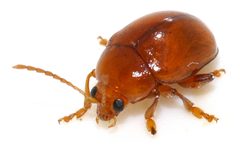
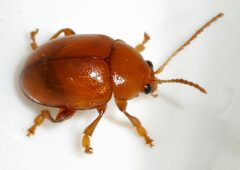
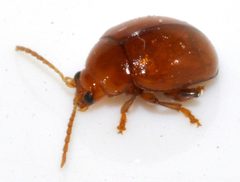
Sphaeroderma testaceum, commonly known as the artichoke , is a flea beetle in the Chrysomelidae. It is native to Europe, North Africa, and Israel, and has been introduced to Atlantic Canada. are active from late spring through early autumn and feed on leaves of thistles and related plants. The is notable as a pest of artichokes and other cultivated thistles.
Pronunciation
How to pronounce Sphaeroderma testaceum: /sfɛːroʊˈdɛrmə tɛsˈtæsɪəm/
These audio files are automatically generated. While they are not always 100% accurate, they are a good starting point.
Identification
Distinguished from the very similar Sphaeroderma rubidum by smaller body size and quadrate (more square-shaped) . Reliable separation requires examination of genitalia. The combination of light brown-orange coloration, wide with closely set , and pronotum with two lateral notches and coarse basal puncturation aids field recognition.
Images
Appearance
Small flea beetle measuring 3.5–4 mm in length. Body shiny light brown-orange. wide with large . positioned close together between eyes. convex, slightly elongate, and quadrate in shape. Pronotum with coarse puncturation basally, prominent corners, a well-defined basal groove, and two lateral notches. Hind enlarged.
Habitat
Wasteland, woodland edges, roadsides, and other areas where plants (thistles and related Asteraceae) occur. Presence is strongly tied to availability of larval and food plants rather than specific vegetation structure.
Distribution
Native to most of Europe, North Africa, and Israel. in Atlantic Canada (introduced, established).
Seasonality
active from May/June to September. New adults emerge in May following spring .
Diet
Both larvae and feed on leaves of thistles and related plants: Carduus, Carlina, Cirsium, Onopordum, Cynara (artichokes), Centaurea nigra (Common Knapweed), and Serratula . In Canada, has been recorded on Cirsium arvense.
Host Associations
- Carduus - food plantlarvae and feed on leaves
- Carlina - food plantlarvae and feed on leaves
- Cirsium - food plantlarvae and feed on leaves; includes C. arvense in Canada
- Onopordum - food plantlarvae and feed on leaves
- Cynara - food plantlarvae and feed on leaves; includes cultivated artichokes
- Centaurea nigra - food plantlarvae and feed on leaves; Common Knapweed
- Serratula - food plantlarvae and feed on leaves
Life Cycle
Overwinters as third (final) instar larvae, sometimes as . occurs in spring. New adults emerge in May. Adults present through September. Larval development occurs on plant leaves.
Ecological Role
Herbivore specializing on thistles and related Asteraceae. May contribute to of weedy thistles, though also damages cultivated artichokes.
Human Relevance
Agricultural pest of artichokes (Cynara ). derives from this association. Introduced to Atlantic Canada, where it has been observed on Cirsium arvense.
Similar Taxa
- Sphaeroderma rubidumExtremely similar external ; distinguished reliably only by genitalia examination, though S. testaceum averages smaller with more quadrate
More Details
Nomenclatural note
GBIF lists this as a synonym of Pistosia testacea, though NCBI and most sources maintain Sphaeroderma testaceum as the accepted name. The basionym is Altica testacea Fabricius, 1775.
North American introduction
The is (introduced and established) in Atlantic Canada, with records on Cirsium arvense, but does not appear to have spread widely in North America based on available distribution data.