
Longitarsus quadriguttatus
(Pontoppidan, 1765)
flea beetle
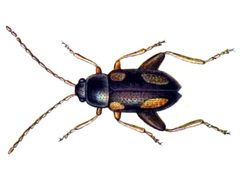
Longitarsus quadriguttatus is a flea beetle (Chrysomelidae) native to Central and south-eastern Europe, Asia Minor, and the Caucasus. It has been introduced to North America as a agent for hound's tongue (Cynoglossum officinale), an weed. feed on leaves while larvae develop as root-feeders inside plant roots. The shows strong host specificity for plants in the Boraginaceae, particularly the tribe Cynoglosseae.
Pronunciation
How to pronounce Longitarsus quadriguttatus: //ˌlɔŋ.ɡɪˈtɑːr.səs ˌkwɒd.rɪˌɡʌˈteɪ.təs//
These audio files are automatically generated. While they are not always 100% accurate, they are a good starting point.
Identification
Distinguished from other Longitarsus by subtle morphological characters not detailed in available sources. As a agent, its association with Cynoglossum officinale and other Boraginaceae species is diagnostically relevant. Distinguished from North American native flea beetles by its specific associations with Eurasian Boraginaceae.
Images
Habitat
Associated with plants in the Boraginaceae, particularly Cynoglossum officinale (hound's tongue) and Echium vulgare (viper's bugloss). In native range, found in Central and south-eastern Europe, Asia Minor, and Caucasus. In introduced range (North America), established in areas where hound's tongue occurs.
Distribution
Native: Central Europe, south-eastern Europe, Asia Minor, Caucasus. Introduced: North America (Canada: Alberta, British Columbia; United States), where established for of hound's tongue.
Seasonality
(one per year). activity synchronized with plant ; specific timing varies by region.
Diet
feed on leaves of Boraginaceae . Larvae feed internally on root tissues of plants.
Host Associations
- Cynoglossum officinale - primary hound's tongue; target for in North America
- Echium vulgare - viper's bugloss
- Boraginaceae - and larvae feed on multiple in this ; strongest association with tribe Cynoglosseae
Life Cycle
. emerge, feed on leaves, and deposit on plant rosettes. Larvae develop inside host roots, completing development below ground. presumably occurs in soil or within root tissues, though specific details not described in sources.
Behavior
Below-ground herbivory by larvae; feed on foliage. Strong fidelity demonstrated in host specificity screening tests.
Ecological Role
Herbivore specialized on Boraginaceae. In North America, deployed as agent to suppress hound's tongue. Narrow range minimizes non-target effects.
Human Relevance
Introduced to North America as agent for hound's tongue (Cynoglossum officinale), a toxic weed of European origin that invades rangelands and displaces native vegetation. specificity studies confirmed safety for non-target plants.
Similar Taxa
- Other Longitarsus speciesMorphologically similar flea beetles; distinguished by associations and subtle morphological characters
- Native North American flea beetles (Chrysomelidae: Alticini)Similar jumping ability and general form; L. quadriguttatus distinguished by its specific association with Eurasian Boraginaceae
More Details
Biological control safety
specificity screening with 49 European plant showed exclusive attack on Boraginaceae. No feeding, oviposition, or larval development occurred on 18 test species in nine other . Occasional attack on non-Cynoglosseae Boraginaceae in laboratory could not be verified in field conditions.
Taxonomic varieties
Three varieties described by Weise in 1888: var. binotatus, var. immaculatus, and var. vittatus. Current taxonomic status of these varieties not assessed in available sources.
Sources and further reading
- BugGuide
- Wikipedia
- GBIF taxonomy match
- iNaturalist taxon
- NCBI Taxonomy
- I fear no weevil… | Beetles In The Bush
- Working with Cerceris fumipennis—Part 2 | Beetles In The Bush
- ID Challenge #19 | Beetles In The Bush
- immatures | Beetles In The Bush | Page 5
- Cicindelidae | Beetles In The Bush | Page 7
- Hymenoptera | Beetles In The Bush | Page 6
- Host Specificity of Longitarsus quadriguttatus Pont., a Below-Ground Herbivore for the Biological Control of Houndstongue
- Host specificity ofLongitarsus quadriguttatus(Pont., 1765) (Col., Chrysomelidae), an agent for the biological control of hound's tongue (Cynoglossum officinaleL., Boraginaceae) in North America