
Disonycha
Chevrolat in Dejean, 1836
Species Guides
32- Disonycha admirabila
- Disonycha alabamae
- Disonycha alternata(Striped Willow Leaf Beetle)
- Disonycha arizonae
- Disonycha balsbaughi
- Disonycha barberi(Snake-Eyes Flea Beetle)
- Disonycha caroliniana
- Disonycha collata(Red-legged Disonycha)
- Disonycha conjugata
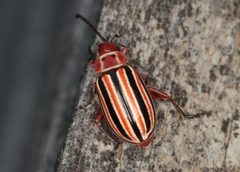
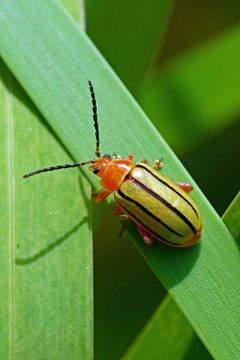
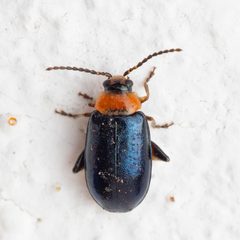
Disonycha is a of flea beetles (Chrysomelidae: Galerucinae: Alticini) containing approximately 170 distributed in the Nearctic and Neotropical regions. Species in this genus are herbivorous, with many showing strong plant specializations including passion vines (Passiflora), willows (Salix), and legumes. Some species exhibit eruptive and at least two passion vine have been documented practicing ( oophagy) by —a first reported for the Galerucinae.
Pronunciation
How to pronounce Disonycha: //dɪˈsɒnɪkə//
These audio files are automatically generated. While they are not always 100% accurate, they are a good starting point.
Images
Habitat
Associated with plants in diverse environments including serpentine barrens, agricultural fields, and natural vegetation . Specific requirements vary by and correspond to host plant distribution.
Distribution
Nearctic and Neotropical regions. Documented in eastern United States (including Vermont), Mexico (Tabasco), and Argentina.
Diet
Herbivorous; larvae and feed on foliage of plants. Documented host associations include Passiflora (passion vines), Salix exigua (coyote willow), Crotalaria longirostrata (longbeak rattlebox), and Alternanthera philoxeroides (alligatorweed). Adults of some have been observed consuming (egg ).
Host Associations
- Passiflora - herbivorepassion vine ; documented
- Salix exigua - herbivoreprimary for D. pluriligata
- Crotalaria longirostrata - pest herbivoreD. teapensis attacks all phenological stages
- Alternanthera philoxeroides - herbivoretarget for by D. argentinensis
Behavior
Some exhibit eruptive characterized by rapid increases. Females make active oviposition choices regarding plant selection. of at least two passion vine species practice oophagy ( ).
Ecological Role
Herbivore; some function as plant with potential for of plants. can lead to significant foliage damage on host plants.
Human Relevance
Some are agricultural pests (e.g., D. teapensis on Crotalaria crops). D. argentinensis has been evaluated as a candidate agent for alligatorweed (Alternanthera philoxeroides) in the United States.
Sources and further reading
- BugGuide
- Wikipedia
- GBIF taxonomy match
- iNaturalist taxon
- NCBI Taxonomy
- Catalogue of Life
- Disonycha xanthomelas (Dalman) (Coleoptera: Chrysomelidae): Host Plants in Eastern U.S. Serpentine Barrens
- Female Behavior and Oviposition Choices by an Eruptive Herbivore, Disonycha pluriligata (Coleoptera: Chrysomelidae)
- Egg cannibalism by passion vine specialist Disonycha Chevrolat beetles (Coleoptera: Chrysomelidae: Galerucinae: Alticini)
- Life History of Disonycha pluriligata (Coleoptera: Chrysomelidae) and Host Plant Relationships with Salix exigua (Salicaceae)
- Biology and Larval Host Range of the Flea Beetle Disonycha argentinensis (Coleoptera: Chrysomelidae) on Alligatorweed in Argentina
- Eruptive Versus Noneruptive Species: A Comparative Study of Host Plant Use by a Sawfly, Euura exiguae (Hymenoptera: Tenthredinidae) and a Leaf Beetle, Disonycha pluriligata (Coleoptera: Chrysomelidae)
- Population Fluctuation of Disonycha teapensis Blake (Coleoptera: Chrysomelidae) in Crotalaria longirostrata Hook. & Arn. (Fabales: Fabaceae) in Huimanguillo, Tabasco, Mexico
- Insights to the host range of the flea beetle Disonycha argentinensis Jacoby, 1992 (Coleoptera: Chrysomelidae), a candidate biological control agent of alligator weed in the U.S.A.