
Disonycha alabamae
Schaeffer, 1919
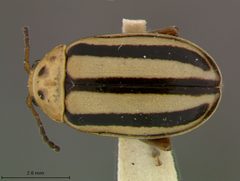
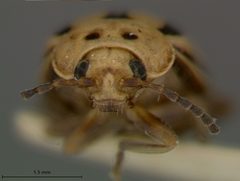
Disonycha alabamae is a flea beetle in the Chrysomelidae, described by Schaeffer in 1919. The is known from limited records in North America. As a member of the Disonycha, it belongs to a group of leaf beetles often associated with specific plants. Available data on this species is sparse, with only three observations documented in iNaturalist.
Pronunciation
How to pronounce Disonycha alabamae: /dɪˈsɒnɪkə æləˈbæmiː/
These audio files are automatically generated. While they are not always 100% accurate, they are a good starting point.
Identification
Members of Disonycha can be distinguished from other flea beetle by their enlarged hind adapted for jumping. -level identification within Disonycha requires examination of genitalia and fine details of coloration and punctation patterns. D. alabamae specifically may be distinguished from by subtle differences in elytral markings and body proportions, though published diagnostic characters are limited.
Images
Distribution
North America. The specific epithet suggests the type locality may be in Alabama, though precise distribution data is limited based on available records.
Behavior
As a flea beetle (tribe Alticini), individuals likely possess the characteristic jumping ability enabled by enlarged hind legs. This serves as an escape mechanism when disturbed.
Similar Taxa
- Disonycha xanthomelasSimilar size and general appearance; both occur in eastern North America. D. xanthomelas has distinct yellow-orange markings on dark and is more frequently encountered.
- Disonycha glabrataOverlapping geographic range; D. glabrata typically shows more uniform coloration and lacks the specific pattern elements that characterize D. alabamae.
More Details
Taxonomic note
The was described by Charles Schaeffer in 1919, a period when many North American chrysomelids were being formally documented. The limited modern records suggest either genuine rarity, undercollection, or possible misidentification with similar .
Data limitations
With only three iNaturalist observations and minimal published literature, most biological details of this remain undocumented. Caution should be exercised in assigning ecological traits from better-known .