
Aphthona flava
Guillebeau, 1894
Copper Leafy Spurge Flea Beetle
Aphthona flava is a flea beetle native to Eurasia, introduced to North America as a agent for leafy spurge (Euphorbia esula). are small, brown, and morphologically cryptic, closely resembling A. cyparissiae and A. nigriscutis. The has established in Manitoba, Canada, where it remains at some release sites, though it is relatively scarce in North Dakota and Minnesota. Native populations occur across Hungary and Italy.
Pronunciation
How to pronounce Aphthona flava: /æfˈθoʊnə ˈflævə/
These audio files are automatically generated. While they are not always 100% accurate, they are a good starting point.
Identification
are difficult to distinguish in the field from Aphthona cyparissiae and Aphthona nigriscutis due to similar brown coloration and small size. Accurate identification likely requires examination of subtle morphological characters or expert verification.
Images
Appearance
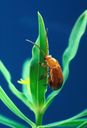
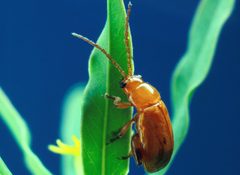
are small flea beetles with brown coloration. Males measure 3.4 mm, females 3.6 mm in length. They resemble typical flea beetles in overall form. Larvae are tiny, white, and worm-like in appearance.
Distribution
Native to Eurasia; widespread in Hungary and Italy. Introduced to North America for biocontrol of leafy spurge. Established in Manitoba, Canada ( at some release sites), North Dakota, and Minnesota, USA.
Seasonality
Larvae active from July through early spring of the following year. occurs from late spring to early summer in soil. emerge from June through early fall when temperatures are suitable.
Diet
Larvae feed initially on root hairs, then on larger roots of leafy spurge (Euphorbia esula). feeding habits are not explicitly documented in available sources.
Host Associations
- Euphorbia esula - herbivoreTarget for biocontrol; larvae feed on roots
Life Cycle
not described in available sources. Larval stage lasts from July through early spring of the following year, with feeding progression from root hairs to larger roots. occurs in soil from late spring to early summer. emerge June through early fall.
Behavior
exhibit flea beetle , jumping when disturbed.
Ecological Role
agent for leafy spurge in North America. Larval root feeding damages plant.
Human Relevance
Introduced intentionally as a biocontrol agent to manage leafy spurge (Euphorbia esula), an weed in North America. Establishment success varies geographically— in some Manitoba sites but relatively scarce in parts of the northern United States.
Similar Taxa
- Aphthona cyparissiae are brown and difficult to distinguish in the field; similar size and coloration
- Aphthona nigriscutis are brown and difficult to distinguish in the field; similar size and coloration