
Colaspis floridana
Schaeffer, 1934
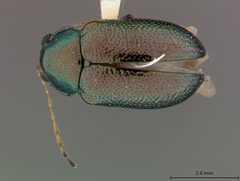
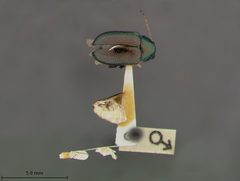
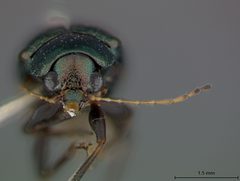
Colaspis floridana is a small leaf beetle in the Chrysomelidae, first described by Charles Schaeffer in 1934 as a variety of Colaspis brunnea and elevated to full rank by Doris Blake in 1974. It occurs in the southeastern United States, with records from Florida, Georgia, North Carolina, and South Carolina. The species feeds on leaves of various plants including crop species and ornamentals, though it has not been reported as an economically damaging pest.
Pronunciation
How to pronounce Colaspis floridana: //kəˈlæspɪs flɔˈrɪdɑːnə//
These audio files are automatically generated. While they are not always 100% accurate, they are a good starting point.
Identification
Distinguished from the closely related Colaspis brunnea by the structure of the elytral : in C. floridana, the first two costae are wider and separated by a single row of punctures, whereas in C. brunnea they are narrower with different spacing. The two also differ in coloration, with C. floridana being paler reddish-brown compared to the darker brown of C. brunnea.
Images
Distribution
Southeastern United States: Florida, Georgia, North Carolina, and South Carolina
Diet
feed on leaves of a wide range of plants including crop (soybean, okra, peanut) and ornamental plants (rose, crapemyrtle). Larvae likely feed underground on roots of grasses and forbs, based on similarity to related species.
Host Associations
- Glycine max - feedingsoybean
- Abelmoschus esculentus - feedingokra
- Arachis hypogaea - feedingpeanut
- Rosa - feedingrose
- Lagerstroemia - feedingcrapemyrtle
Life Cycle
Larvae feed underground on roots, overwinter underground, and emerge as the following year. This pattern is inferred from closely related such as C. brunnea, as specific studies of C. floridana larvae have not been published.
Human Relevance
Has been observed feeding on leaves of several agricultural and ornamental plant , but has not been reported as an economically damaging pest. Not considered a significant agricultural pest.
Similar Taxa
- Colaspis brunneaVery similar in overall appearance; distinguished by narrower first two elytral with different puncture spacing, and darker brown coloration
More Details
Taxonomic history
Originally described as a variety of Colaspis brunnea by Schaeffer in 1933 (published 1934), then elevated to full rank by Blake in 1974. A later species described under the same name by Blake in 1977 was found to be a homonym and was renamed C. pseudofavosa by Edward Riley.
Sources and further reading
- BugGuide
- Wikipedia
- GBIF taxonomy match
- iNaturalist taxon
- Rediscovery of Cicindela scabrosa floridana | Beetles In The Bush
- Photographing the Newly Rediscovered Cicindelidia floridana | Beetles In The Bush
- The (almost) Florida-endemic Cicindelidia scabrosa | Beetles In The Bush
- Mini-review of the Cicindelidia abdominalis species-group | Beetles In The Bush
- Why I Roamed the Marsh at Night | Beetles In The Bush
- ID Challenge #10 | Beetles In The Bush