
Cryptocephalus quadruplex
Newman, 1840
Black and Red Sumac Leaf Beetle
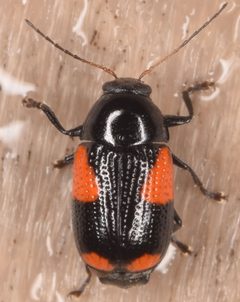
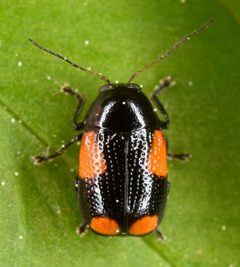
Cryptocephalus quadruplex is a case-bearing leaf beetle in the Chrysomelidae. The occurs across North America, with records from Canada (Manitoba, Nova Scotia, Ontario) and the United States. As a member of the case-bearing leaf beetles, its larvae construct protective cases from fecal matter and sometimes plant debris. The species has been observed on sumac (Rhus) and other vegetation in prairie and open woodland .
Pronunciation
How to pronounce Cryptocephalus quadruplex: /krɪptoʊˈsɛfələs kwɑːˈdrʌplɛks/
These audio files are automatically generated. While they are not always 100% accurate, they are a good starting point.
Identification
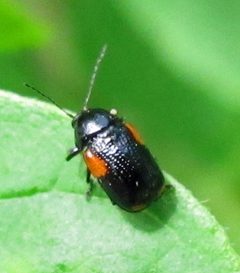
This can be recognized by its distinctive black and red coloration, which gives it the Black and Red Sumac . The specific epithet "quadruplex" likely refers to a four-part color pattern. are small leaf beetles typical of the Cryptocephalus, with a rounded body form and enlarged hind . Accurate identification to species level requires examination of genitalia or reference to detailed taxonomic keys, as many Cryptocephalus species exhibit similar morphologies.
Images
Habitat
Open including prairies, sand prairies, and dry-mesic upland deciduous forests. Associated with sumac (Rhus aromatica and related ) and other herbaceous vegetation. One observation records the species on flowers of fragrant sumac in dry-mesic deciduous upland forest.
Distribution
North America. Documented from Canada: Manitoba, Nova Scotia, Ontario. Present throughout the United States. The appears to be widespread but locally distributed, with scattered records rather than continuous range documentation.
Seasonality
have been observed in mid-spring through summer. Specific data is limited, but the likely follows the typical pattern for temperate Cryptocephalus with adult activity beginning when plants leaf out.
Diet
feed on foliage of sumac (Rhus spp.) and potentially other plants. Larval diet unknown but presumed to include leaves of the same host plants used by adults, based on typical cryptocephaline .
Host Associations
- Rhus aromatica - food plant observed on flowers
- Rhus - food plantsumac foliage
Life Cycle
are deposited in or on plant tissue. Larvae construct portable cases from fecal material and plant debris, which they carry while feeding. occurs within the larval case. emerge and feed on host plant foliage. Specific timing of developmental stages is undocumented.
Behavior
have been observed on flowers, suggesting they may feed on pollen or nectar in addition to foliage. The case-bearing habit of larvae provides protection from and desiccation.
Ecological Role
Herbivore contributing to nutrient cycling in prairie and open woodland . Larval cases may provide microhabitat for other small organisms.
Human Relevance
No significant documented impacts. The is of interest to entomologists and naturalists. One iNaturalist observation reached 400 records, indicating some citizen science documentation.
Similar Taxa
- Cryptocephalus notatusSimilar size and preferences, distinguished by color pattern and genitalia
- Other Cryptocephalus speciesMany share similar ; precise identification requires examination