
Clytrini
W. Kirby, 1837
Tribe Guides
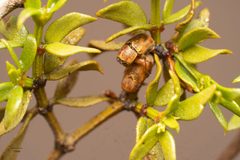
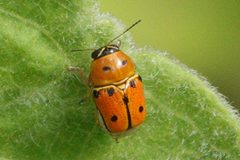
3Clytrini is a tribe of case-bearing leaf beetles within the Cryptocephalinae, historically treated as a distinct subfamily Clytrinae. The tribe belongs to the Camptosomata, a group characterized by larvae that construct protective cases from fecal material and shed skins. Clytrini are distributed across the Palearctic, Afrotropical, and Oriental regions, with notable diversity in the Mediterranean, Near East, Arabian Peninsula, and China. The tribe is distinguished by myrmecophilous associations, with many living in close relationship with ants.
Pronunciation
How to pronounce Clytrini: //klɪˈtraɪ.naɪ//
These audio files are automatically generated. While they are not always 100% accurate, they are a good starting point.
Identification
Clytrini are distinguished from other Cryptocephalinae by the combination of myrmecophilous habits and case-bearing larval . typically exhibit compact, convex body forms with enlarged hind in some . The tribe shares the Camptosomata characteristic of larvae constructing portable cases, but specific tribal-level morphological synapomorphies require detailed examination of mouthparts and genitalia. Identification to genus relies on antennal structure, tibial spination, and elytral pattern; -level determination requires examination of male genitalia and spermatheca morphology.
Images
Habitat
Mediterranean shrublands, steppe grasslands, and open woodland edges in the Palearctic region. In the Afrotropical region, associated with savanna and semi-arid vegetation. Arabian Peninsula occur in arid and semi-arid environments including wadi systems and desert oases. Chinese species recorded from montane regions of Qinghai, Yunnan, and Xinjiang at varying elevations.
Distribution
Palearctic Region: widespread from Europe through Central Asia to China; Afrotropical Region: sub-Saharan Africa including Senegal, Sudan, Namibia, Angola, Ethiopia, Abyssinia, Zanzibar, Togo, Dahomey, Chad, Ennedi, and Guinea; Oriental Region: Arabian Peninsula (Oman, Yemen, United Arab Emirates), with new described from Lebanon, Israel, and the broader Eastern Mediterranean. Specific Chinese records from Qinghai, Yunnan, and Xinjiang provinces.
Seasonality
activity observed during spring breeding season in northern Algeria (March–May). Seasonal patterns in other regions not documented in available sources.
Diet
Herbivorous: Labidostomis taxicornis feeds on a wide range of plants including weeds and cultivated , with Rumex L. (Polygonaceae) documented as the preferred food source for during the breeding season in Algeria. Broader tribal-level feeding patterns not established.
Host Associations
- Rumex sp. (Polygonaceae) - preferred food and mating site for of Labidostomis taxicornisdocumented in northern Algeria
- Rhynocoris erythropus (Hemiptera: Reduviidae) - main natural of Labidostomis taxicornis
- Bloodiella andalusica (Hymenoptera: Trichogrammatidae) - reared from of Labidostomis taxicornis and Macrolenes dentipes in France and Italy
Life Cycle
Larvae are case-bearing, constructing portable protective cases from fecal material and shed skins—a defining trait of the Camptosomata. Females of Labidostomis taxicornis lay on herbaceous plants other than their preferred food source. Egg clusters are parasitized by trichogrammatid wasps. Detailed developmental stages and duration not documented.
Behavior
Myrmecophilous: Clytrini are known for -associated habits, though the specific nature of these relationships varies by . Mating observed on plants; females of Labidostomis taxicornis are polyandrous. Larvae carry portable cases throughout development.
Ecological Role
Herbivores that may cause significant damage to plants, including cultivated . Serve as for including parasitoids (Trichogrammatidae) and (Reduviidae). associations suggest potential role in ant or as myrmecophilous .
Human Relevance
Labidostomis taxicornis identified as a pest causing significant damage to cultivated plants in Algeria. Some may be of concern in agricultural settings where they feed on crop plants or weeds in systems.
Similar Taxa
- Cryptocephaliniother tribe in Cryptocephalinae; distinguished by generally lacking the pronounced myrmecophily characteristic of Clytrini and differences in larval case construction details
- Clytrinae (historical concept)now synonymized under Cryptocephalinae; modern classification places Clytrini as a tribe rather than based on phylogenetic analysis of Camptosomata relationships
More Details
Taxonomic history
Historically treated as Clytrinae, now classified as tribe Clytrini within Cryptocephalinae based on phylogenetic relationships among Camptosomata. This reclassification reflects improved understanding of case-bearing leaf beetle evolution.
Reproductive biology
Labidostomis taxicornis exhibits female-biased sex ratio (SR=0.55) and polyandrous mating system, with first documentation from Algeria in 2018. Oviposition occurs on herbaceous plants distinct from feeding sites.
Sources and further reading
- BugGuide
- Wikipedia
- iNaturalist taxon
- Catalogue of Life
- Bioecology of Labidostomis taxicornis (Chrysomelidae: Cryptocephalinae: Clytrini) in Tizi-Ouzou region, Northern Algeria
- A synopsis on the Chinese species of Clytra Laicharting, with description of two new species (Coleoptera: Chrysomelidae: Cryptocephalinae: Clytrini)
- Revision of the genus Paraclytra (Coleoptera: Chrysomelidae: Cryptocephalinae: Clytrini), with description of P. cervenkai sp. nov. from Sultanate of Oman
- Contribution to the knowledge of the Clytrini of the Eastern Mediterranean, the Near East and the Arabian Peninsula, with descriptions of four new species (Coleoptera: Chrysomelidae: Cryptocephalinae)
- First rearing records of Bloodiella andalusica Nowicki, 1935 (Hymenoptera: Chalcidoidea, Trichogrammatidae) in France, from the eggs of Labidostomis taxicornis and Macrolenes dentipes (Coleoptera: Chrysomelidae, Clytrini)