
Lema cyanella
Linnaeus, 1758
Californian Thistle Leaf Beetle
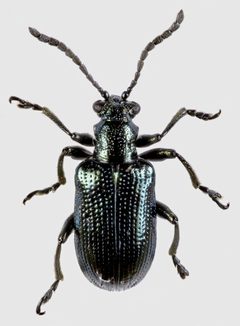
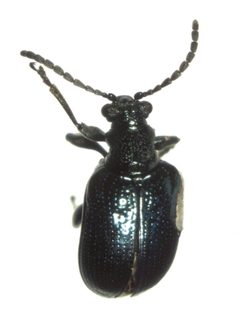
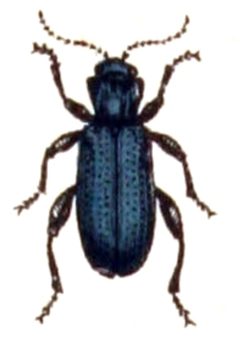
Lema cyanella is a leaf beetle in the Chrysomelidae investigated as a agent for Canada thistle (Cirsium arvense). In Europe, it has been observed breeding primarily on C. arvense, though laboratory studies demonstrate broader feeding and reproductive capacity on Cirsium, Carduus, and Silybum . The was introduced to New Zealand in 1981 and evaluated for release in North America. Females lay an average of 1564 , with development from egg to taking approximately 17.6 days under controlled temperature conditions.
Pronunciation
How to pronounce Lema cyanella: /ˈlɛmə saɪəˈnɛlə/
These audio files are automatically generated. While they are not always 100% accurate, they are a good starting point.
Images
Distribution
Native to the Palearctic region, with records from Spain, France, the United Kingdom, Germany, Italy, the Czech Republic, Austria, Hungary, Serbia, Bosnia and Herzegovina, Denmark, Norway, Finland, Russia, and Lithuania. Also recorded in Asia (India, Taiwan, South Korea, China) and Oceania. Introduced to New Zealand in 1981, where establishment has been limited. Evaluated for introduction to North America as a agent.
Diet
and larvae feed on thistles in the Cirsium, Carduus, and Silybum. Cirsium arvense (Canada thistle) is the main in Europe.
Host Associations
- Cirsium arvense - primary Main in Europe; target for
- Cirsium drummondii - laboratory Preferred over C. arvense in laboratory choice tests
- Carduus spp. - laboratory Supports feeding and in laboratory conditions
- Silybum spp. - laboratory Supports feeding and in laboratory conditions
Life Cycle
Development from to takes 17.6 days at 25°C day/20°C night (average approximately 23°C). Females lay an average of 1564 eggs.
Behavior
Exhibits feeding and oviposition preference hierarchy, with flowering plants preferred over stunted conspecifics. In field cage tests, concentrated feeding and -laying on individual Cirsium drummondii plants that were thriving, even when other host plants were available.
Ecological Role
Candidate agent for Canada thistle (Cirsium arvense), a significant agricultural weed. Based on comparative evidence with other thistle-feeding insects, predicted to concentrate breeding on introduced Cirsium arvense without damaging native Cirsium in North America.
Human Relevance
Imported to New Zealand in 1981 and released in 1983 as a agent for thistles, with additional mass-rearing and distribution in the 1990s; establishment has been limited. Evaluated for release in North America to control Canada thistle in wheat fields. Field-collected colonies may carry , requiring -free stock for intentional releases. No economic plants are attacked.
More Details
Biological Control History
Initial introduction to New Zealand in 1981 used -free progeny released in 1983, which failed to prosper. A second introduction in 1990 with mass-rearing and distribution in the 1990s also had limited success, though some establishment appears to have occurred. This pattern paralleled experience in Canada.
Disease Risk
Field-collected beetles from Germany were found infected with , a microsporidian . Recommendations for North American release emphasize the need for -free colonies to avoid introducing alongside the control agent.
Sources and further reading
- BugGuide
- Wikipedia
- GBIF taxonomy match
- iNaturalist taxon
- NCBI Taxonomy
- Deadly dining: Three-lined potato beetle, Lema daturaphila — Bug of the Week
- Evidence for Biodiversity Insurance Hypothesis: More Species Are Indeed Beneficial
- Hiking at Don Robinson State Park | Beetles In The Bush
- crab diversity | Blog
- HOST SPECIFICITY AND SUITABILITY OF LEMA CYANELLA (COLEOPTERA: CHRYSOMELIDAE), A CANDIDATE FOR THE BIOLOGICAL CONTROL OF CANADA THISTLE (CIRSIUM ARVENSE)
- HOST RANGE OFLEMA CYANELLA(COLEOPTERA: CHRYSOMELIDAE), A CANDIDATE FOR BIOCONTROL OF CANADA THISTLE, AND OF FOUR STENOPHAGOUS, FOREIGN THISTLE INSECTS IN NORTH AMERICA