
Microtheca ochroloma
Stål, 1860
Yellow-margined Leaf Beetle, Yellowmargined Leaf Beetle
Microtheca ochroloma is a leaf beetle in the Chrysomelidae, native to South America and in North America. It is a significant agricultural pest of cruciferous crops, with documented in the southeastern United States. Development from to takes approximately 17–57 days depending on temperature, with optimal survival around 20–25°C. The exhibits strong preferences, favoring turnip and mustard while showing least preference for collard and cabbage.


Pronunciation
How to pronounce Microtheca ochroloma: //ˌmaɪkroʊˈθiːkə ˌɒkroʊˈloʊmə//
These audio files are automatically generated. While they are not always 100% accurate, they are a good starting point.
Identification
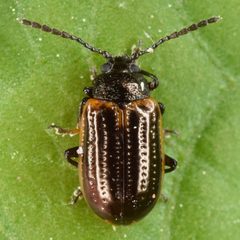
are small leaf beetles in the Chrysomelidae. The 'yellow-margined' refers to the distinctive pale marginal coloration on the . Specific diagnostic features distinguishing it from other Microtheca or similar chrysomelids are not documented in available sources.
Images
Habitat
Agricultural fields and production systems planted with cruciferous crops (Brassicaceae), including both conventional and organic farming systems. Has been observed in field mustard plantings where both immatures and exhibit aggregated spatial distribution patterns.
Distribution
Native to South America; in North America with established in the southeastern United States. GBIF records confirm presence in North America and South America, including the conterminous 48 United States. Predicted northern distribution based on cold extends to Kansas, Illinois, Kentucky, and Virginia.
Diet
Foliage of cruciferous plants in the Brassicaceae. Documented include cabbage (Brassica oleracea var. capitata), collard (B. oleracea var. acephala), mustard (B. juncea), turnip (B. rapa), and radish (Raphanus sativus). Shows strong feeding preference for turnip and mustard foliage; collard and cabbage are least preferred.
Host Associations
- Brassica oleracea var. capitata - cabbage; least preferred
- Brassica oleracea var. acephala - collard; least preferred , lowest
- Brassica juncea - mustard; strongly preferred
- Brassica rapa - turnip; strongly preferred, highest
- Raphanus sativus - radish; intermediate preference
Life Cycle
Complete with stages: , four larval instars, prepupal, pupal, and . Mean development time from oviposition to adult is 26.6 days on turnip and 27.5 days on cabbage at optimal temperatures. Temperature-dependent development ranges from 17 days at 30°C to 57 days at 15°C. Total required for complete development: 333, with lower developmental threshold of 7.3–9.8°C. Survival from egg to adult is approximately 80% at 15–25°C but drops to 24% at 30°C.
Behavior
Exhibits aggregated spatial distribution of both immatures and on plants. Third instar larvae and adults demonstrate strong feeding preferences in choice tests, actively selecting turnip and mustard over other hosts. Host finding and acceptance involve behavioral mechanisms that discriminate among cruciferous crop .
Ecological Role
Herbivorous pest of cruciferous crops in agricultural . Acts as a folivore that can reduce crop yield and quality through direct feeding damage. are influenced by plant chemistry, with glutathione S-transferase activity varying up to 10-fold between different host plants.
Human Relevance
Agricultural pest requiring management in crucifer production, particularly in organic systems. Chemical control studies indicate larvae are most susceptible to esfenvalerate, followed by carbaryl and malathion. Cold data suggest potential for range expansion in North America. No beneficial uses documented.
Similar Taxa
- Other Microtheca speciesSame , likely similar in size and general chrysomelid ; identification requires examination of specific elytral margin coloration and other subtle characters not detailed in available sources
- Other Brassicaceae-feeding ChrysomelidaeShare similar associations and ; distinguished by specific host preferences and the characteristic yellow-margined elytral pattern of M. ochroloma
More Details
Temperature and Development
Development is strongly temperature-dependent. At 30°C, fourth instar leaf consumption is 7.4-fold lower than at 15–25°C, indicating heat stress reduces feeding . are the most cold-tolerant stage (LT50 13 days, LT90 38 days at 0°C), while first instar larvae are most susceptible to cold temperatures.
Host-Mediated Fitness
plant significantly affects multi- performance. Beetles reared on cabbage failed to survive beyond the second generation, demonstrating that host choice has consequences beyond immediate feeding preferences. varies nearly 2.5-fold between optimal (turnip: ~491 /female) and suboptimal (collard: ~199 eggs/female) hosts.
Sources and further reading
- BugGuide
- Wikipedia
- GBIF taxonomy match
- iNaturalist taxon
- NCBI Taxonomy
- Biology, Ecology, and Management of Microtheca ochroloma (Coleoptera: Chrysomelidae) in Organic Crucifer Production
- The Biology and Ecology of the Yellowmargined Leaf Beetle, Microtheca Ochroloma Stal, (Coleoptera: Chrysomelidae) on Crucifers.
- Host Finding and Acceptance Preference of the Yellowmargined Leaf Beetle, Microtheca ochroloma (Coleoptera: Chrysomelidae), on Cruciferous Crops
- Temperature-Dependent Development and Cold Tolerance ofMicrotheca ochroloma(Coleoptera: Chrysomelidae), a Pest of Cruciferous Crops in the Southeastern United States