
Stenispa metallica
(Fabricius, 1801)
Black Smooth Hispine
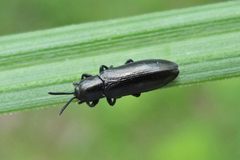
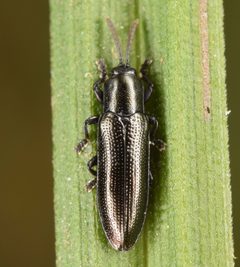
Stenispa metallica is a of hispine in the Chrysomelidae. are characterized by a shining black body with an obscure metallic tinge. The species has been recorded from a broad range of states in the eastern and central United States, as well as from Mexico. Larval development is associated with sedges and grasses, with Scirpus atrovirens documented as a confirmed plant.
Pronunciation
How to pronounce Stenispa metallica: /stɛˈnɪs.pə məˈtæl.ɪ.kə/
These audio files are automatically generated. While they are not always 100% accurate, they are a good starting point.
Identification
Stenispa metallica can be distinguished from similar hispine beetles by its elongate, subparallel body form with nearly four times the length of the . The combination of shining black coloration with obscure metallic tinge, pentangular scutellum, and distinctly punctate- elytra with subsinuate margins is diagnostic. The thorax is finely but distinctly punctured with non-crowded punctures. Specimens may be confused with other black hispines, but the specific proportions and punctation pattern, along with the slightly elytral apices at the , aid in identification.
Images
Appearance
are shining black with an obscure metallic tinge. The is scarcely longer than broad, with parallel sides that are indistinctly sinuate. The angles are slightly produced and obtuse, while the angles are acute. The thorax is subcylindrical above, finely but distinctly punctured with punctures that are not very crowded. The scutellum is pentangular. The are scarcely broader than the thorax, nearly four times its length, with narrowly margined sides that are subsinuate and narrowed behind toward the apex. The apex of each elytron is rounded, and together they are slightly at the . The sutural angle above is convex, and the elytra are distinctly punctate-. The surface is distinct and shining black.
Habitat
Associated with wetland and riparian where plants in the Cyperaceae and Poaceae occur. have been collected from sedges (Carex stricta, Carex hyalinolepis, Scirpus atrovirens) and grasses (Andropogon virginicus, Spartina ).
Distribution
North America: United States (Alabama, Connecticut, District of Columbia, Florida, Georgia, Illinois, Indiana, Iowa, Kansas, Kentucky, Louisiana, Maryland, Massachusetts, Michigan, Minnesota, Mississippi, Missouri, Nebraska, New Jersey, New York, North Carolina, Ohio, Oklahoma, Pennsylvania, Rhode Island, South Carolina, South Dakota, Tennessee, Texas, Virginia, West Virginia, Wisconsin) and Mexico (Tamaulipas). Central America.
Diet
Larvae feed internally on stems of plants, with Scirpus atrovirens documented as a confirmed host. have been observed on Carex stricta, Carex hyalinolepis, Andropogon virginicus, and Spartina , though whether they feed on these plants or use them for other purposes is not established.
Host Associations
- Scirpus atrovirens - larval Confirmed plant for larval development
- Carex stricta - association collected on this plant
- Carex hyalinolepis - association collected on this plant
- Andropogon virginicus - association collected on this plant
- Spartina - association collected on Spartina
Life Cycle
Larvae are stem borers in plants. Specific details of , larval instars, , and timing are not documented.
Ecological Role
As a stem-boring herbivore, larvae likely influence plant growth and nutrient cycling in wetland sedge . The full ecological role has not been studied.
Similar Taxa
- Other Stenispa speciesSimilar body form and coloration; identification requires examination of specific punctation patterns, thoracic proportions, and elytral shape
More Details
Taxonomic history
Originally described by Fabricius in 1801. The has been variously treated in literature as a tortoise beetle or hispine, reflecting historical uncertainty in subfamilial classification within Chrysomelidae.
Collection records
The broad eastern and central U.S. distribution, with a single Mexican state record (Tamaulipas), suggests the may be more continuously distributed than current records indicate, or that collecting effort has been uneven across its range.