
Octotoma marginicollis
Horn, 1883
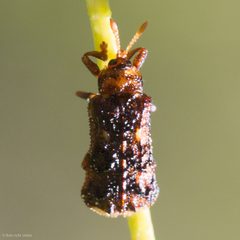
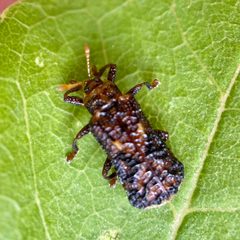
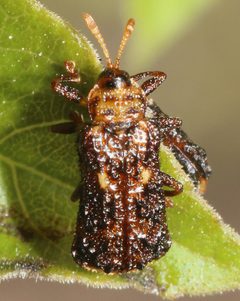
Octotoma marginicollis is a leaf beetle ( Chrysomelidae, Cassidinae) occurring in the southwestern United States and Mexico. have been recorded feeding on Perezia thurberi and collected from a variety of woody and herbaceous plants including Fraxinus, Baccharis, Brickellia, Viguiera, and Monarda . The species was described by Horn in 1883.
Pronunciation
How to pronounce Octotoma marginicollis: /ˌɑk.toʊˈtoʊ.mə ˌmɑr.dʒɪ.nɪˈkoʊ.lɪs/
These audio files are automatically generated. While they are not always 100% accurate, they are a good starting point.
Images
Distribution
Southwestern United States (Arizona, California, New Mexico, Texas, Utah) and Mexico (Coahuila, Guanajuato, Jalisco, Morelos, Tamaulipas).
Diet
feed on Perezia thurberi. Adults have been collected on Fraxinus greggii, Fraxinus velutina, Fraxinus attenuata, Baccharis bigelovii, Baccharis glutinosa, Brickellia californica, Brickellia floribunda, Viguiera cordiflua, and Monarda menthaefolia.
Host Associations
- Perezia thurberi - feedingprimary recorded food plant
- Fraxinus greggii - association collected on plant
- Fraxinus velutina - association collected on plant
- Fraxinus attenuata - association collected on plant
- Baccharis bigelovii - association collected on plant
- Baccharis glutinosa - association collected on plant
- Brickellia californica - association collected on plant
- Brickellia floribunda - association collected on plant
- Viguiera cordiflua - association collected on plant
- Monarda menthaefolia - association collected on plant
More Details
Taxonomic Note
Octotoma marginicollis belongs to the tribe Chalepini within the tortoise beetle Cassidinae. The Octotoma contains approximately 20 described distributed primarily in the Americas.
Collection Records
The has been documented from 38 iNaturalist observations as of the knowledge cutoff date.