
Chalepus sanguinicollis
(Linnaeus, 1771)
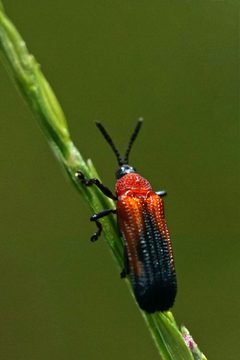
Chalepus sanguinicollis is a leaf beetle in the Chrysomelidae, Cassidinae. The was described by Linnaeus in 1771 and has a broad distribution across the Caribbean, North America, and South America. It is known to feed on several grass species including Panicum leucophaeum and Paspalum densum, and have been collected from multiple plant .

Pronunciation
How to pronounce Chalepus sanguinicollis: /ˈkælɪpəs ˌsæŋɡwɪnɪˈkoʊlɪs/
These audio files are automatically generated. While they are not always 100% accurate, they are a good starting point.
Images
Distribution
Caribbean Sea, North America, and South America. Specific records include Brazilian states: Amazonas (BR-AM), Bahia (BR-BA), Espírito Santo (BR-ES), Goiás (BR-GO), Mato Grosso (BR-MT), Paraná (BR-PR), Rio Grande do Sul (BR-RS), Santa Catarina (BR-SC), and São Paulo (BR-SP).
Diet
Larvae have been recorded feeding on Panicum leucophaeum and Paspalum densum. have been collected on Verbesinae greenmanni, Benthamantha mollis, Bromelia caragua, Vitex cimosa, Valota insularis, Calea pinnatifida, and Crotalaria .
Host Associations
- Panicum leucophaeum - larval food plant
- Paspalum densum - larval food plant
- Verbesinae greenmanni - collection site
- Benthamantha mollis - collection site
- Bromelia caragua - collection site
- Vitex cimosa - collection site
- Valota insularis - collection site
- Calea pinnatifida - collection site
- Crotalaria - collection site
More Details
Taxonomic note
The was originally described by Linnaeus in 1771, making it one of the earlier described chrysomelid beetles. It belongs to the tribe Chalepini within the tortoise beetle Cassidinae.