
Anisostena ariadne
Newman, 1841
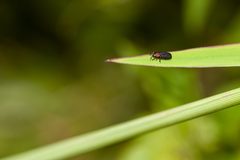
Anisostena ariadne is a of hispine leaf beetle in the Chrysomelidae, first described by Newman in 1841. measure 4.6–5.3 mm in length and are characterized by black with a purple iridescent hue. The species has been documented feeding on switchgrass (Panicum virgatum). It is widely distributed across the eastern and central United States, with records from 18 states and the District of Columbia.
Pronunciation
How to pronounce Anisostena ariadne: /ænɪˈsɒstinə əˈriːədniː/
These audio files are automatically generated. While they are not always 100% accurate, they are a good starting point.
Identification
The combination of small size (under 6 mm), black with purple iridescence, and association with Panicum grasses distinguishes this from similar hispine beetles. Members of the Microrhopala, which co-occur in similar , typically exhibit different color patterns and body proportions. Anisostena species are distinguished from other hispine genera by their antennal structure and elytral punctation patterns.
Images
Appearance
are small leaf beetles measuring 4.6–5.3 mm in length. The are black with a distinct purple iridescent sheen. As a member of the Cassidinae, it possesses the typical hispine body form—somewhat flattened and adapted for living on grass leaves.
Habitat
Associated with grassland , particularly where grasses occur. The has been collected in prairie remnants, open woodlands, and other areas supporting stands of Panicum virgatum.
Distribution
Eastern and central United States: Alabama, Arkansas, Delaware, District of Columbia, Florida, Georgia, Kentucky, Louisiana, Maryland, Mississippi, Missouri, New Jersey, North Carolina, Oklahoma, South Carolina, Tennessee, Texas, Virginia, and West Virginia.
Diet
have been observed feeding on Panicum virgatum (switchgrass). Larval diet is presumed to be the same plant, though this has not been explicitly documented.
Host Associations
- Panicum virgatum - food sourceswitchgrass
Ecological Role
As a herbivore on native grasses, this contributes to the natural herbivore load on prairie vegetation. Its specific ecological impacts have not been quantified.
Similar Taxa
- Microrhopala spp.Co-occurring hispine leaf beetles found in similar prairie and grassland , but distinguished by different color patterns and body form
- Other Anisostena speciesCongeneric share similar ; precise identification requires examination of antennal and genitalic characters
More Details
Taxonomic history
First described by Edward Newman in 1841, this has remained relatively obscure in the entomological literature, with most records stemming from general surveys rather than targeted study.
Collection method
Based on field observations of related hispine beetles, this is likely most effectively collected by sweeping herbaceous vegetation, particularly stands of its grass.