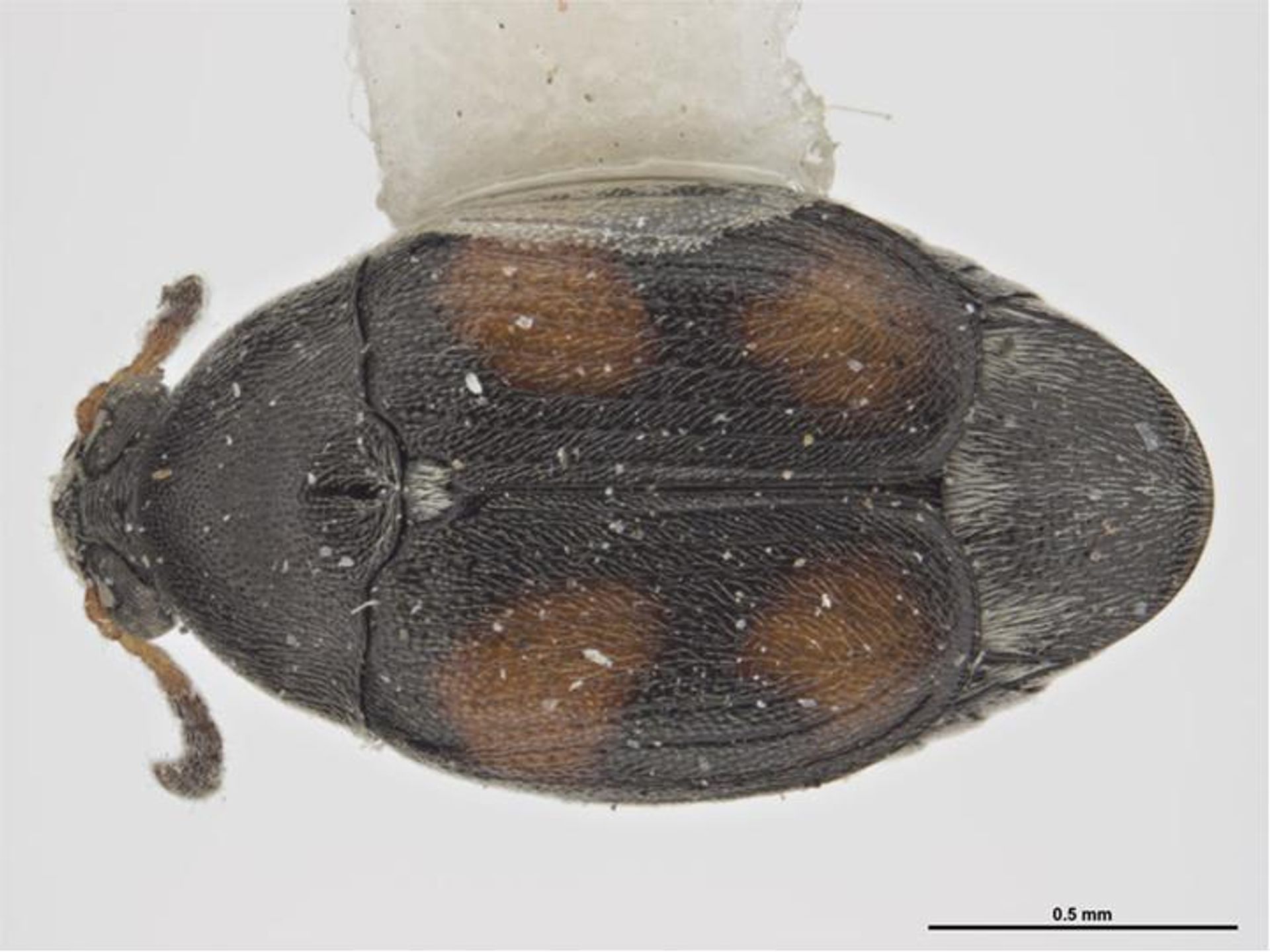
Stator limbatus
(Horn, 1873)
Stator limbatus is a leaf beetle in the Chrysomelidae, native to the southwestern United States, Mexico, and northern South America. It has established in multiple regions outside its native range, including Hawaii, South Africa, the Middle East, and Mediterranean islands. The occupies xeric and semi-arid environments and has been documented feeding on legume seeds.


Pronunciation
How to pronounce Stator limbatus: /ˈsteɪtɔr lɪmˈbeɪtəs/
These audio files are automatically generated. While they are not always 100% accurate, they are a good starting point.
Identification
Stator limbatus can be distinguished from other Stator by its elongated body form and the pattern of the . As a member of the Bruchinae (seed beetles), it shares the characteristic short, broad with large and short typical of the group. Specific diagnostic features require examination of genitalia and detailed elytral .
Images
Habitat
Xeric, semi-arid, and dry tropical environments. Native occur in desert and arid scrubland vegetation. Introduced populations have established in similarly dry conditions in their new ranges.
Distribution
Native: southwestern United States, Mexico, and northern South America. Introduced: Hawaii, South Africa, Middle East, Sardinia (Italy), and Corsica (France) as of 2021.
Diet
Feeds on seeds of a wide variety of legumes (Fabaceae).
Host Associations
- Fabaceae - food plantbroad range across multiple legume
Ecological Role
Seed on legumes. As an introduced , it may impact native legume and seed bank dynamics in invaded regions.
Human Relevance
Agricultural pest potential on stored legumes and field crops. Its spread to new regions has been documented in recent years, suggesting ongoing range expansion facilitated by human activity.
Similar Taxa
- Other Stator speciesSimilar body plan and seed-feeding ; require detailed examination of male genitalia and elytral punctation patterns for definitive identification
- Bruchus speciesFormerly classified in this ; share general bruchine but differ in specific structural characters