
Bruchidius villosus
(Fabricius, 1792)
broom seed beetle, Scotch broom bruchid
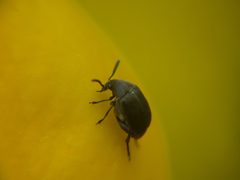
Bruchidius villosus is a small seed-feeding in the Chrysomelidae, native to Europe and introduced to North America and New Zealand as a agent for Scotch broom (Cytisus scoparius). It has been deliberately released in the United States since the 1990s to reduce seed production in this weed. In New Zealand, it has exhibited problematic range expansion to non-target leguminous plants. The is approximately 2 mm in length with dark gray coloration.
Pronunciation
How to pronounce Bruchidius villosus: /bruˈkɪdiːəs vɪˈloʊsəs/
These audio files are automatically generated. While they are not always 100% accurate, they are a good starting point.
Identification
Distinguished from other Bruchidius by its small size (approximately 2 mm), dark gray coloration, and specific association with Cytisus scoparius seed pods. Accurate identification to species level requires examination of genitalia or expert taxonomic verification, as external may overlap with . In North America, its presence is strongly indicative of deliberate or accidental introduction, as it is not native.
Images
Appearance
Dark gray weevil approximately 2 mm in length. The body form is compact and typical of bruchine beetles, with a somewhat rounded profile. Larvae are gelatinous white, 1–2 mm long.
Habitat
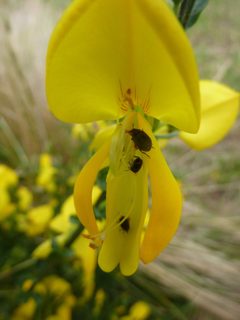
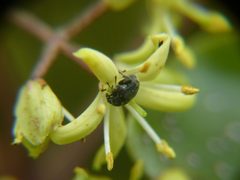
Associated with stands of Scotch broom (Cytisus scoparius) and related leguminous plants in tribe Genisteae. Occurs in disturbed , roadsides, and areas where plants grow. In its native European range, inhabits natural and semi-natural environments where host plants occur.
Distribution
Native to Europe. Introduced to North America (United States, including North Carolina; Canada) and New Zealand. Established present in introduced ranges.
Seasonality
Activity tied to flowering and seed pod development of plants. coincides with seed pod maturation and splitting. Specific seasonal timing varies by geographic location and climate.
Diet
Specialized seed feeding on seeds of leguminous plants, primarily Cytisus scoparius (Scotch broom). In New Zealand, has expanded to other leguminous plants in tribe Genisteae.
Host Associations
- Cytisus scoparius - primary Scotch broom; target of efforts
- Genisteae (tribe) - expanded rangein New Zealand, includes non-target leguminous
Life Cycle
Female lays approximately 10 on exterior of seed pods. Larva hatches at egg attachment point, burrows into pod, and develops while feeding on seeds. Larva pupates within the seed coat. emerges when seed pod ripens and splits open.
Behavior
Oviposition involves placement of directly on seed pods. Larval development is endophytic, occurring entirely within seed pods. are short-lived and do not feed on foliage; their primary activity is and to new host plants.
Ecological Role
Seed that reduces reproductive output of plants. Functions as a agent in introduced ranges, though efficacy varies. In New Zealand, host range expansion has raised concerns about non-target effects on native and ornamental legumes.
Human Relevance
Primary use is as a agent against Scotch broom (Cytisus scoparius). Deliberately released in the United States beginning in the 1990s. In New Zealand, its use is limited due to documented non-target attack on plants other than the intended . Represents a cautionary example in risk assessment.
Similar Taxa
- Other Bruchidius speciesMorphological similarity; accurate identification requires examination of genitalia or molecular methods
- Other Bruchinae (seed beetles)Shared of seed in legumes; distinguished by association and subtle morphological differences
More Details
Biological Control History
Introduced to the United States by accident prior to deliberate release programs. Following discovery of its seed-reducing effects on Scotch broom, it became one of the most recently approved insects for deliberate release in the 1990s. Its viability and efficacy continue to be studied.
Risk Assessment Caution
The New Zealand experience, where B. villosus expanded its range to non-target Genisteae, has been cited as a cautionary tale in risk analysis. This case influenced subsequent host-range testing protocols and highlighted the importance of native-range research for non-target risk assessment.
Sources and further reading
- BugGuide
- Wikipedia
- GBIF taxonomy match
- iNaturalist taxon
- NCBI Taxonomy
- Urban Wonder: Rare Butterfly Thrives in One of Ecuador's Largest Cities
- Oedemeridae | Beetles In The Bush
- Lake Tahoe, California | Beetles In The Bush
- Biology of Bruchidius villosus (Coleoptera: Bruchidae) on Scotch Broom in North Carolina
- Can sibling species explain the broadening of the host range of the broom seed beetle,Bruchidius villosus(F.) (Coleoptera: Chrysomelidae) in New Zealand?