
Atimia confusa
(Say, 1827)
Small Cedar Borer, Small Cedar-bark Borer
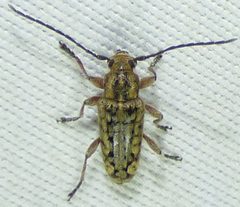
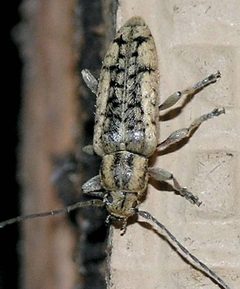
Atimia confusa is a of long-horned beetle in the Cerambycidae. It is native to North America and has been documented in both Canada and the United States. The species was first described by Thomas Say in 1827. It belongs to the small tribe Atimiini within the diverse cerambycid family.
Pronunciation
How to pronounce Atimia confusa: //əˈtɪmiə kənˈfjuːsə//
These audio files are automatically generated. While they are not always 100% accurate, they are a good starting point.
Identification
The Atimia is characterized by relatively small size compared to many cerambycids, with typically measuring under 15 mm in length. Members of this genus often exhibit muted coloration and may show subtle in antennal length. Definitive identification to level requires examination of genitalic structures and detailed comparison with , particularly A. helenae and A. mexicana, which overlap in parts of its range. The three recognized (A. c. confusa, A. c. dorsalis, and A. c. maritima) differ in geographic distribution and subtle morphological features.
Images
Habitat
Associated with coniferous forests, particularly those containing cedar (Thuja), juniper (Juniperus), and related Cupressaceae . Larval development occurs in the bark and outer wood of living or recently dead trees. have been observed on vegetation and are attracted to lights.
Distribution
North America, with records from Canada (Ontario, Quebec, and eastern provinces) and the United States (widespread in the eastern and central states, with western representing the A. c. dorsalis). The subspecies A. c. maritima is restricted to coastal regions of the Pacific Northwest.
Seasonality
activity period extends from late spring through summer, with peak typically occurring in June and July. Larval development spans multiple years, with occurring in late spring.
Diet
Larvae feed phloeophagously in the inner bark and cambium layer of Cupressaceae , particularly Thuja occidentalis (northern white cedar) and Juniperus . have been observed feeding on pollen and may take nectar at flowers, though this is not well documented.
Host Associations
- Thuja occidentalis - larval primary ; northern white cedar
- Juniperus - larval junipers and related
- Cupressaceae - larval general association
Life Cycle
Complete with a multi-year larval stage. are deposited in bark crevices of trees. Larvae tunnel in the phloem and outer sapwood, creating irregular galleries. occurs in a chamber constructed near the bark surface. emerge through exit holes and are active for several weeks. The typically requires two to three years to complete, though this varies with geographic location and host condition.
Behavior
are primarily and , often found resting on vegetation during daylight hours. They exhibit positive and are frequently collected at ultraviolet light traps. Mating occurs on host trees, with males locating females through contact .
Ecological Role
As a primary bark borer in Cupressaceae, this contributes to the natural turnover of weakened or conifers. Larval tunneling creates for secondary successional organisms and accelerates nutrient cycling in forest . The species is not considered a significant economic pest, though localized damage may occur in ornamental plantings.
Human Relevance
Minor significance as a forest insect. Occasionally encountered by entomologists and naturalists during biodiversity surveys. Not known to cause substantial damage to timber or ornamental plantings. The serves as an indicator of mature coniferous forest .
Similar Taxa
- Atimia helenaeOverlaps in eastern North American range; distinguished by male genitalic structure and subtle differences in pronotal
- Atimia mexicanaPotentially sympatric in southwestern portions of range; generally larger with more elongate body form
- Psenocerus supernotatusSimilar size and coloration in eastern forests; distinguished by more pronounced elytral and different antennal proportions
More Details
Taxonomic History
The was originally described as Callichroma confusa by Thomas Say in 1827. It was subsequently transferred to the Atimia, which was established by Haldeman in 1847. The A. c. dorsalis was described by LeConte in 1869 from western , and A. c. maritima was described by Linsley in 1939 from coastal Pacific Northwest material. The taxonomic boundaries between these subspecies remain based primarily on geographic distribution and subtle morphological differentiation.
Conservation Status
Not formally assessed by IUCN or NatureServe. Widespread distribution and association with common suggest stable , though localized declines may accompany loss of mature coniferous forest .
Sources and further reading
- BugGuide
- Wikipedia
- GBIF taxonomy match
- iNaturalist taxon
- Catalogue of Life
- UC Davis-Based Projects: To Bee or Not to Bee? | Bug Squad
- Diversity of Bugs at Bohart Museum of Entomology | Bug Squad
- ZooKeys with 5 of the Top 10 Marine Species | Blog
- Interview: description of two African shovel-snout snakes from Angola
- Year of the Snake: a serpent selection to celebrate Lunar New Year!