
Pseudogaurotina
Plavilstshikov, 1958
Species Guides
2- Pseudogaurotina abdominalis
- Pseudogaurotina cressoni(Metallic Fir Borer)
Pseudogaurotina is a of longhorn beetles in the Cerambycidae, Lepturinae, and tribe Rhagiini. Established by Plavilstshikov in 1958, the genus contains six described distributed across the Palearctic region. Species within this genus are characterized by their metallic coloration and elongated body form typical of lepturine flower longhorns.
Pronunciation
How to pronounce Pseudogaurotina: /sjuːdoʊɡaʊˈroʊtɪnə/
These audio files are automatically generated. While they are not always 100% accurate, they are a good starting point.
Identification
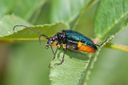
of Pseudogaurotina can be distinguished from related in Rhagiini by their robust, somewhat flattened body shape and strong metallic luster, often green or blue-green. The pronotum is typically narrower than the elytral bases and lacks prominent lateral . are and of moderate length, not exceeding the . The genus name reflects its similarity to Gaurotina, from which it can be separated by structural details of the male genitalia and elytral punctuation patterns.
Images
Distribution
The is distributed across the Palearctic region. Pseudogaurotina excellens occurs in Central Europe (Slovakia, Hungary, Romania), P. magnifica in the Caucasus region, P. splendens in Central Asia, and P. abdominalis and P. cressoni in North America. The disjunct distribution suggests a relictual biogeographic pattern.
Similar Taxa
- GaurotinaShares tribe Rhagiini and general body form; Pseudogaurotina was historically confused with this . Separated by male genitalia structure and finer details of elytral .
- BrachytaAnother Rhagiini with metallic coloration. Brachyta typically have more strongly punctured and different antennal proportions.
- LepturaLarger in same with similar flower-visiting habits. Leptura generally have more contrasting color patterns (yellow and black) rather than uniform metallic hues.
More Details
Species list
The contains six recognized : Pseudogaurotina abdominalis (Bland, 1862), P. cressoni (Bland, 1864), P. excellens (Brancsik, 1874), P. magnifica Plavilstshikov, 1958, P. robertae Pesarini & Sabbadini, 1997, and P. splendens (Jakovlev, 1893).
Etymology
The prefix 'pseudo-' (Greek for 'false') indicates the 's close resemblance to Gaurotina, from which it was distinguished as a separate lineage.