
Stenostrophia amabilis
(LeConte, 1857)
flower longhorn
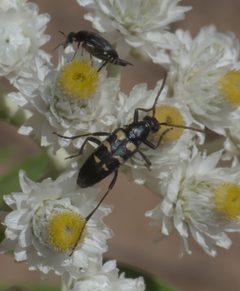
Stenostrophia amabilis is a of flower longhorn beetle in the Cerambycidae, first described by LeConte in 1857. It belongs to the Lepturinae, a group commonly known as flower longhorns due to their frequent association with blossoms. The species is found in North America, with records from the western United States and Canada. have been observed visiting flowers of composite plants (Asteraceae), a typical for lepturine cerambycids.
Pronunciation
How to pronounce Stenostrophia amabilis: /stɛnoʊˈstroʊfiə əˈmæbɪlɪs/
These audio files are automatically generated. While they are not always 100% accurate, they are a good starting point.
Images
Distribution
North America. Documented from British Columbia, Canada, and the western United States (California, Arizona). GBIF records indicate presence in CA and US.
Host Associations
- Heliomeris longifolia - visitation observed feeding on flowers; flowers collected with specimens
- Heterotheca fulcrata - visitation observed on flowers
- Hymenothrix wrightii - visitation observed on flowers
- Gutierrezia microcephala - visitation observed on flowers
- Solidago velutina - visitation observed on flowers
Behavior
are flower visitors, actively foraging on composite flowers during daylight hours. Multiple individuals have been observed co-occurring on the same flower alongside other Acmaeodera , suggesting non-aggressive nectar or pollen feeding . No observations of larval behavior are available.
Similar Taxa
- Acmaeodera amabilisSimilar specific epithet and shared flower-visiting on Asteraceae; distinguished by -level characters (Buprestidae vs. Cerambycidae) and antennal length (cerambycids have long )
- Stenostrophia tribalteataCongeneric with potentially overlapping western North American distribution; S. amabilis distinguished by specific elytral maculation pattern and geographic range
More Details
Flower association patterns
Observations from Kitt Peak, Arizona (September 2019) document occurring abundantly on multiple composite in the same , with co-occurrence of A. amabilis, A. amplicollis, A. decipiens, and A. rubronotata on overlapping floral resources. This suggests broad polyphagy for adult feeding among Asteraceae.