
Oplosia nubila
(LeConte, 1862)
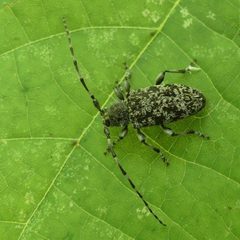
Oplosia nubila is a longhorn beetle (Cerambycidae) described by John Lawrence LeConte in 1862. It belongs to the Lamiinae and tribe Acanthoderini. The is native to North America, with confirmed records from Canadian provinces including Manitoba, Ontario, and Québec. As with other members of its , it is a wood-boring whose larvae develop in dead or decaying wood.
Pronunciation
How to pronounce Oplosia nubila: /oʊˈploʊʒə njuˈbɪlə/
These audio files are automatically generated. While they are not always 100% accurate, they are a good starting point.
Images
Habitat
Associated with forested environments where woody vegetation occurs. Larvae develop in dead or decaying wood, consistent with the of related Acanthoderini .
Distribution
North America. Documented from Manitoba, Ontario, and Québec in Canada.
Ecological Role
Contributes to wood decomposition and nutrient cycling in forest through larval feeding activity in dead wood.
More Details
Taxonomic History
First described by John Lawrence LeConte in 1862, a prominent 19th-century American entomologist who described numerous North American .
Data Limitations
Detailed biological information for this is sparse in available sources. Most aspects of its , , and remain undocumented in the accessible literature.
Sources and further reading
- BugGuide
- Wikipedia
- GBIF taxonomy match
- iNaturalist taxon
- Catalogue of Life
- Stalk-boring insect pests - AgriLife Extension Entomology
- Bt Corn Adoption Benefits Other Crops, Too
- Conventional Soil Management Draws European Corn Borer Toward Bt Corn
- Anthranilic Diamides Can Potentially Replace Neonicotinoid Seed Treatments in Vegetable Crops
- New Technique May Help Farmers Identify the European Corn Borer
- Farmer Feedback: Needs Assessment Reveals Growers' Views on Corn Insect Pests in Iowa