
Amannus vittiger
LeConte, 1858
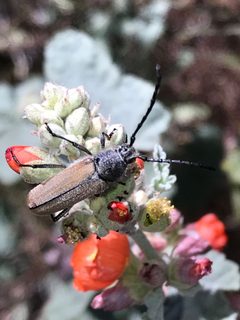
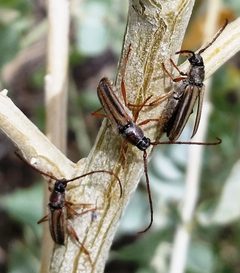
Amannus vittiger is a of longhorn beetle in the Cerambycidae, first described by John Lawrence LeConte in 1858. Field observations indicate are active flower visitors, particularly associated with globemallow flowers (Sphaeralcea spp.) in the southwestern United States. The species occurs in arid and semi-arid of the Colorado Plateau region.
Pronunciation
How to pronounce Amannus vittiger: /əˈmænəs ˈvɪtɪdʒər/
These audio files are automatically generated. While they are not always 100% accurate, they are a good starting point.
Images
Habitat
Arid and semi-arid environments of the southwestern United States, including roadside vegetation in desert and semi-desert landscapes. Observed in association with sandy soils and open areas where flowers bloom.
Distribution
Southwestern United States. Documented from northeastern Arizona (Coconino County), southern Utah (Kane County), and northwestern New Mexico. Distribution records from GBIF confirm presence in the United States.
Seasonality
active in early to mid-June based on field observations from 2025. Activity coincides with blooming period of globemallow flowers (Sphaeralcea spp.).
Diet
have been observed visiting flowers of Sphaeralcea coccinea (scarlet globemallow) and Sphaeralcea parvifolia (small-leaved globemallow), suggesting nectar or pollen feeding. Larval diet unknown.
Host Associations
- Sphaeralcea coccinea - flower visitation collected from flowers in Utah and Arizona
- Sphaeralcea parvifolia - flower visitation collected from flowers in Arizona
Behavior
are flower visitors. Multiple individuals have been observed together on the same flower patch, suggesting at blooming resources. Readily collected by sweeping flowering vegetation.
Similar Taxa
- Other Amannus species-level similarity in body form and antennal structure; specific distinguishing features for A. vittiger not documented in available sources
- Other TrachyderiniTribe members share robust body form and often visit flowers; A. vittiger may be distinguished by specific elytral patterning (implied by specific epithet 'vittiger' meaning 'striped') but detailed comparisons unavailable
More Details
Etymology
The specific epithet 'vittiger' derives from Latin, meaning 'bearing stripes' or 'striped', likely referring to elytral coloration patterns.