
Heterachthes quadrimaculatus
Haldeman, 1847
Four-spotted Hickory Borer
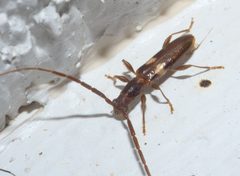
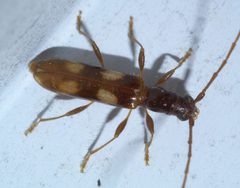
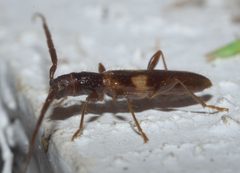
Heterachthes quadrimaculatus is a of longhorn beetle in the Cerambycidae, described by Haldeman in 1847. The "Four-spotted Hickory Borer" reflects both its distinctive markings and its known association with hickory trees. Its plant has been documented as Carya glabra (pignut hickory). The species occurs in eastern North America, with records from Canada (Ontario, Québec) and the United States.
Pronunciation
How to pronounce Heterachthes quadrimaculatus: /ˌhɛtɚˈæk.θiz ˌkwɑd.rɪˌmæk.jəˈleɪ.təs/
These audio files are automatically generated. While they are not always 100% accurate, they are a good starting point.
Identification
The specific epithet "quadrimaculatus" (four-spotted) suggests four distinct markings on the , a common diagnostic pattern in Cerambycidae. As a member of the Cerambycinae , it likely exhibits the elongated body form and long characteristic of longhorn beetles. Definitive identification requires examination of antennal structure, pronotal shape, and elytral patterns typical of the Heterachthes.
Images
Habitat
Associated with hickory-dominated forests and woodlands, given its documented relationship with Carya glabra. The likely occupies deciduous hardwood forests where its host plant occurs.
Distribution
Eastern North America. Documented from Canada: Ontario, Québec; and the United States. GBIF records confirm presence in North America with specific Canadian provincial records.
Diet
Larval development occurs within the wood of Carya glabra (pignut hickory). The specific feeding habits of are not documented in available sources.
Host Associations
- Carya glabra - plantpignut hickory; documented for larval development
Ecological Role
As a wood-boring cerambycid, larvae contribute to nutrient cycling in forest through decomposition of dead and dying hickory wood. The is a primary consumer of woody plant material in its larval stage.
Human Relevance
Potential minor pest of hickory trees; no significant economic impact documented. The is of interest to coleopterists and forest entomologists studying cerambycid diversity and associations.
Similar Taxa
- Neocompsa cylindricollisCatalogue of Life lists H. quadrimaculatus as an ambiguous synonym under N. cylindricollis, indicating historical taxonomic confusion between these
- Other Heterachthes species-level similarity in antennal and body proportions; H. quadrimaculatus distinguished by four-spotted elytral pattern and hickory association
More Details
Taxonomic Note
Catalogue of Life lists Heterachthes quadrimaculatus as an "ambiguous synonym" under Neocompsa cylindricollis, suggesting ongoing taxonomic uncertainty or historical reclassification that requires verification. GBIF accepts H. quadrimaculatus as a valid .
Nomenclature
The specific epithet quadrimaculatus (Latin: four-spotted) is descriptive, likely referring to four distinct elytral maculations. The "Four-spotted Hickory Borer" combines this diagnostic feature with its known plant association.
Sources and further reading
- BugGuide
- Wikipedia
- GBIF taxonomy match
- iNaturalist taxon
- Catalogue of Life
- Mosquitoes, Malaria and the Civil War | Bug Squad
- Meloidae Holdings | Entomology Research Museum
- Publications | Entomology Research Museum
- Anopheles quadrimaculatus mosquito larvae in pollen - Entomology Today
- Plant Pollen May Be Important Food Source for Some Mosquitoes in U.S.
- How One State's Mosquito Data Could Reduce Risk of Malaria Returning to U.S.