
Curius
Newman, 1840
Species Guides
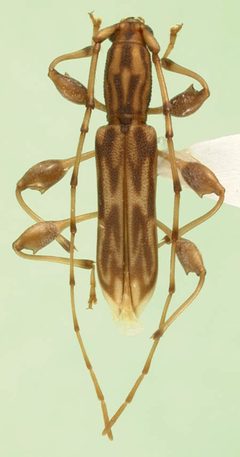
1Curius is a of longhorn beetles (Cerambycidae) and the sole genus in the tribe Curiini. It contains four described distributed in the Americas. The genus was established by Newman in 1840. Members are classified in the Cerambycinae, a diverse group of wood-boring beetles.


Pronunciation
How to pronounce Curius: /ˈkjuː.ri.əs/
These audio files are automatically generated. While they are not always 100% accurate, they are a good starting point.
Images
Distribution
The occurs in the Americas. Curius dentatus is known from the United States and Mexico. Curius panamensis occurs in Panama. Curius chemsaki and Curius punctatus have more restricted ranges in Central America.
More Details
Taxonomic uniqueness
Curiini is a tribe, making Curius phylogenetically isolated within Cerambycinae. This unusual tribal placement suggests distinctive morphological or molecular characteristics that warrant separate tribal status, though specific diagnostic features are not well documented in accessible literature.
Species diversity
The contains four : Curius chemsaki Nearns & Ray, 2006; Curius dentatus Newman, 1840; Curius panamensis Bates, 1885; and Curius punctatus (Fisher, 1932). Two species were described in the 19th century, one in 1932, and the most recent in 2006, indicating sporadic taxonomic attention.