
Agallissini
LeConte, 1873
Genus Guides
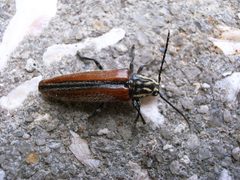
3Agallissini is a tribe of longhorn beetles in the Cerambycinae, established by LeConte in 1873. The tribe contains three —Agallissus, Osmopleura, and Zagymnus—with five described . North American species have been documented with specific plant associations, particularly with palms.
Pronunciation
How to pronounce Agallissini: //əˌɡæləˈsɪsaɪni//
These audio files are automatically generated. While they are not always 100% accurate, they are a good starting point.
Identification
Members of Agallissini can be distinguished from other Cerambycinae tribes by a combination of morphological characters including the structure of the and pronotum. The Zagymnus is characterized by (wrinkled) pronotal surfaces in some , reflected in epithets such as Z. rugicollis. Detailed diagnostic features require examination of and reference to original descriptions.
Images
Habitat
North American are associated with palm , specifically with Sabal palmetto (cabbage palmetto) as a documented larval . The tribe's distribution suggests tropical and subtropical affinities.
Distribution
The tribe occurs in the New World. North American records include the southeastern United States (Florida and coastal regions), Mexico, and Central America. Agallissus extends into South America. Specific distributions: Osmopleura chamaeropis and Zagymnus clerinus are documented in the southeastern United States; Zagymnus rugicollis and Z. variatus have more restricted ranges in the southwestern United States and Mexico.
Diet
Larvae feed internally in plant stems. Documented larval host for North American is Sabal palmetto (Arecaceae). feeding habits are not documented in available sources.
Host Associations
- Sabal palmetto - larval Documented for North American Agallissini ; larvae develop within stems of this palm species
Life Cycle
Larval development occurs within plant stems, typical of internal-feeding cerambycid beetles. Specific details on -laying, larval instars, sites, and time are not documented in available sources.
Ecological Role
As stem-boring larvae in palms, these beetles contribute to nutrient cycling through wood decomposition and may serve as prey for . Their specific ecological impacts on native palm have not been quantified.
Human Relevance
Potential minor pest of ornamental palms, though no significant economic damage has been documented. Primarily of interest to cerambycid and collectors due to restricted distributions and association with palm .
Similar Taxa
- Other Cerambycinae tribesAgallissini is distinguished by the combination of antennal and pronotal ; confusion most likely with similarly compact, palm-associated cerambycines such as some Callichromini or Trachyderini, which differ in tarsal structure and elytral
More Details
Taxonomic History
The tribe was established by LeConte in 1873 and has remained stable in composition, containing only three . The genus Zagymnus was revised by Chemsak and Linsley in 1968, who described two new .