
Zenoa picea
(Palisot de Beauvois, 1805)
Serrate Cedar Beetle
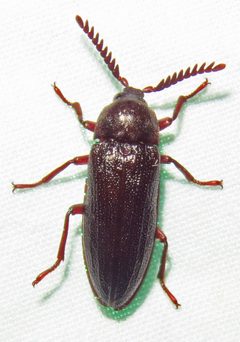
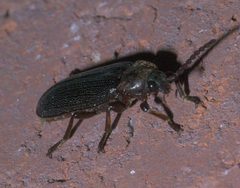
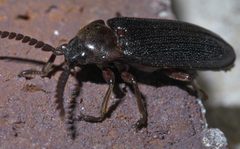
Zenoa picea is the sole member of the Callirhipidae occurring north of Mexico, and the only in the Zenoa. This is associated with coniferous forests, particularly spruce (Picea), where its larvae develop in decaying wood. The species was described in 1805 and has been recorded across much of the eastern and central United States.
Pronunciation
How to pronounce Zenoa picea: //ˈzɛn.oʊ.ə ˈpaɪ.si.ə//
These audio files are automatically generated. While they are not always 100% accurate, they are a good starting point.
Identification
The only Callirhipidae in the United States and Canada; distinguished from other North American beetles by -level characters including serrate and distinctive body form. Larvae possess a , well-developed legs, and specific chaetotaxy patterns; pupae exhibit exarate features with free appendages.
Images
Habitat
Coniferous forests, specifically associated with spruce trees (Picea ). Larvae occur in decaying wood of trees.
Distribution
United States: recorded from 26 states and the District of Columbia, ranging from Florida north to New Jersey, west to Iowa and Texas. No confirmed records from Mexico or Canada.
Host Associations
- Picea - larval development in decaying woodspruce trees
Life Cycle
Larval and pupal stages occur in decaying wood of coniferous . Larvae described as having distinctive , well-developed legs, and specific chaetotaxy patterns. Pupae exhibit typical exarate features with free appendages.
Ecological Role
Larvae contribute to wood decomposition processes in coniferous forests through development in decaying wood.
Similar Taxa
- Other Callirhipidae contains approximately 8 and 30 globally, but Zenoa picea is the only member occurring north of Mexico; other species restricted to Central and South America, Madagascar, and Asia.
Sources and further reading
- BugGuide
- GBIF taxonomy match
- iNaturalist taxon
- Unusual Galls Trigger National Survey of Adelgids and Their Predators in Bhutan Forests
- The Pest Management Methods That Deliver Picture-Perfect Christmas Trees
- A winter longhorned beetle | Beetles In The Bush
- After 150 years, a butterfly finds its name
- Pensoft Editorial Team | Blog - Part 134
- Uncategorized | Blog - Part 30
- Immature Stages of Zenoa picea (Palisot de Beauvois, 1805) (Coleoptera: Dryopoidea: Callirhipidae): Notes on Morphology and Distribution
- Distribution Records for <i>Zenoa Picea</i> (Palisot De Beauvois, 1805) (Coleoptera: Callirhipidae) From the United States.