
Mastogenius subcyaneus
(LeConte, 1860)
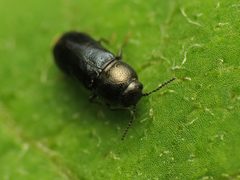
Mastogenius subcyaneus is a of metallic wood-boring beetle in the Buprestidae, one of the smallest members of the family in North America. measure approximately 2 mm in length. The Mastogenius belongs to the tribe Trachyini, whose larvae exhibit the unusual habit of mining within leaves rather than boring through wood. The species occurs in North America and has been documented in oak woodland .
Pronunciation
How to pronounce Mastogenius subcyaneus: //ˌmæstəˈdʒɛniəs sʌbˈsaɪəˌniəs//
These audio files are automatically generated. While they are not always 100% accurate, they are a good starting point.
Identification
Distinguished from other North American Buprestidae by its extremely small size (~2 mm). Within Mastogenius, separation from requires examination of fine morphological details not reliably documented in available literature. The genus is distinguished from the similar-sized and similarly-shaped genus Brachys by genitalic characters and larval associations. Field identification to level is challenging and typically requires specimen examination.
Images
Habitat
Oak woodland . Based on related in the and tribe, likely associated with Quercus (oak) species. Available documentation specifically notes occurrence in dry oak/pine sandhill woodland.
Distribution
North America. Documented occurrences include the southeastern United States, specifically Florida. GBIF records indicate presence in the Nearctic region.
Host Associations
- Quercus - probable larval Inferred from congeneric and tribe-level patterns; not directly confirmed for M. subcyaneus
Life Cycle
As with other Trachyini, larvae are leaf miners rather than wood borers. Specific details of the for M. subcyaneus are not documented.
Behavior
have been collected by beating oak foliage. Activity patterns and specific are not well documented.
Ecological Role
As a leaf-mining , larvae likely contribute to nutrient cycling in oak woodland . Specific ecological impacts are unknown given the ' minute size and limited study.
Human Relevance
No documented economic or agricultural significance. Of interest to coleopterists and biodiversity researchers due to its minute size and phylogenetic position within the aberrant tribe Trachyini.
Similar Taxa
- Brachys ovatusSimilar minute size (~5 mm, still larger than Mastogenius) and flattened body form; distinguished by larger size, presence of dense row of long hairs along apex of last abdominal sternum, and white-margined band of bronze on
- Brachys aerosusSimilar size range (3-5 mm) and general appearance; distinguished by predominantly gold to bronze on and association with broader range of hardwoods beyond oaks
- Mastogenius puncticollis of similar size; distinguished by fine morphological details including punctation patterns on pronotum and , requiring specimen examination
More Details
Tribe-level characteristics
Mastogenius subcyaneus belongs to tribe Trachyini, one of the most morphologically derived groups within Buprestidae. Members of this tribe exhibit a highly modified form—flat, compact, and wedge-shaped—associated with their unique larval habit of leaf mining rather than wood boring. This represents a significant ecological shift within the .
Collection challenges
Due to its minute size, M. subcyaneus is easily overlooked in field surveys. Standard beating and sweeping techniques in oak are most likely to yield specimens. The was noted as a target species that a collector hoped to encounter but did not find during a 2024 Florida survey, suggesting it may be genuinely scarce or difficult to detect.