Acmaeoderopsis hulli
(Knull, 1928)
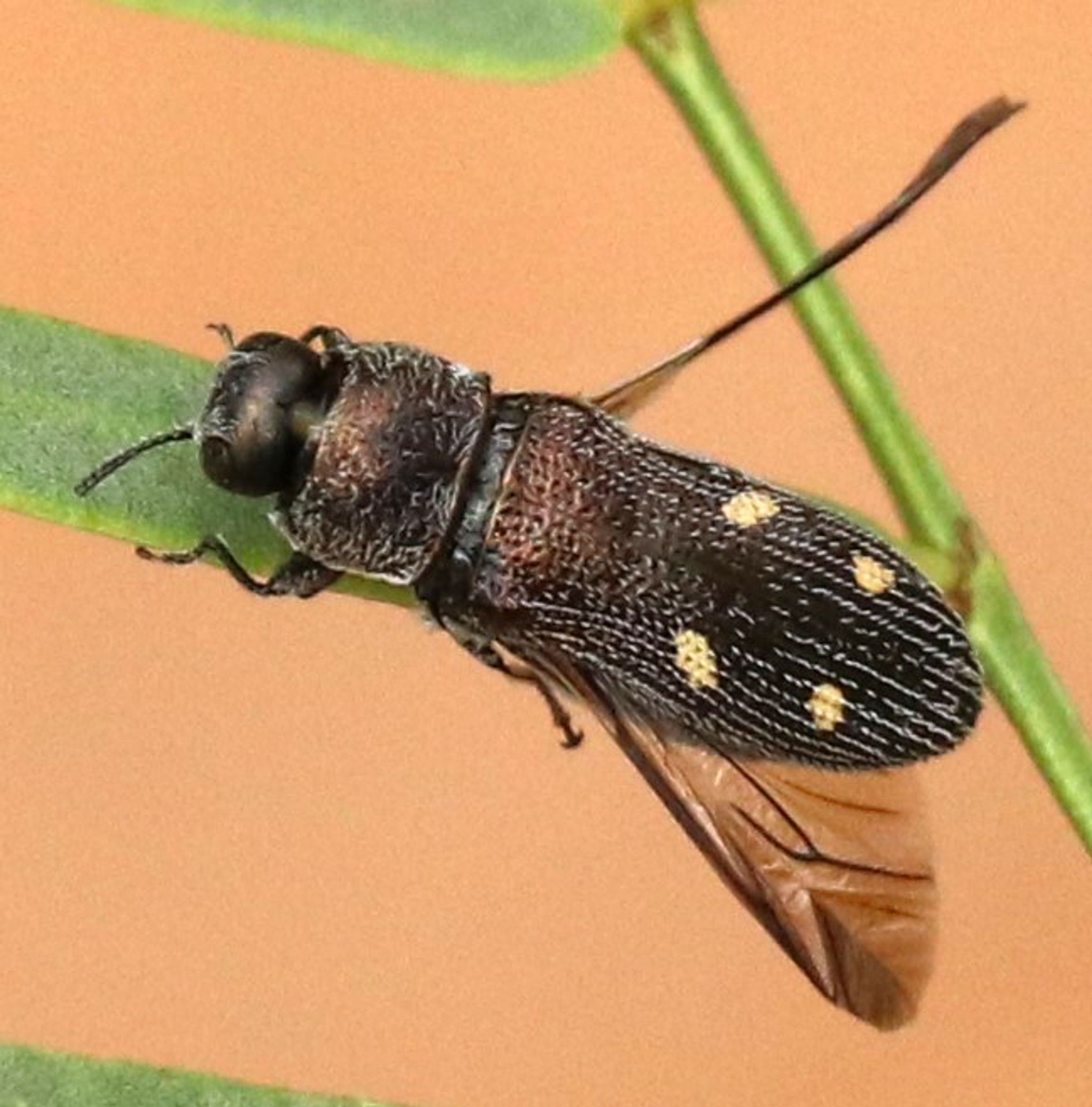
Acmaeoderopsis hulli is a metallic wood-boring beetle in the Buprestidae, occurring in Central America and North America. The has been documented from mesquite-dominated in the southwestern United States and northern Mexico. are associated with Prosopis glandulosa (honey mesquite) and have been collected by beating branches and sweeping foliage. The Acmaeoderopsis is a small group within Buprestidae with limited published biological information.
Pronunciation
How to pronounce Acmaeoderopsis hulli: /ˌæk.miː.oʊ.dəˈrɒp.sɪs ˈhʌl.aɪ/
These audio files are automatically generated. While they are not always 100% accurate, they are a good starting point.
Identification
Acmaeoderopsis hulli belongs to a distinguished from the related and more diverse Acmaeodera by subtle morphological differences in antennal structure and body form. Within Acmaeoderopsis, A. hulli can be recognized by its characteristic elytral pattern and overall body proportions. The genus is less commonly encountered than Acmaeodera in field collections, making specimens notable finds. are typically small to medium-sized for the , with the characteristic metallic coloration of buprestid beetles.
Images
Habitat
Mesquite-dominated including mesquite/saltbush chaparral and mesquite/oak chaparral. have been collected from Prosopis glandulosa (honey mesquite) growing on rocky gypsum/red siltstone slopes and in sand dune environments. The occurs in arid and semi-arid environments with scattered woody vegetation.
Distribution
Central America and North America. Documented from New Mexico (Chaves County, Eddy County), Texas, and presumably northern Mexico. The has been recorded from the Pecos River valley, Mescalero Sands area, and bottomlands in eastern New Mexico.
Seasonality
have been collected in mid-to-late May and early June. Activity appears to coincide with the period when mesquite foliage is fully developed and flowering plants are available in the .
Host Associations
- Prosopis glandulosa - association collected by beating and sweeping foliage; also swept from Quercus havardii (shin oak) in sand dune , suggesting possible broader range or incidental occurrence
Behavior
are and have been observed flying to branch tips of mesquite when disturbed during beating. They exhibit typical buprestid of rapid, darting when alarmed. Adults have been found resting on foliage and are attracted to ultraviolet light.
Similar Taxa
- Acmaeodera speciesSimilar size, metallic coloration, and association with mesquite; Acmaeoderopsis distinguished by -level characters including antennal structure
- Acmaeoderopsis junkiCongeneric occurring in similar southwestern ; distinguished by specific elytral patterns and body proportions