
Acmaeodera robigo
Knull, 1954
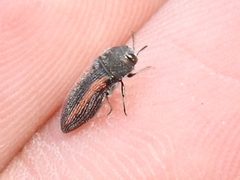
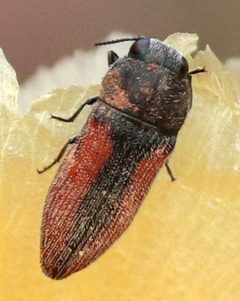
Acmaeodera robigo is a small metallic wood-boring beetle in the Buprestidae, first described by Josef Knull in 1954 from specimens collected at Lake Corpus Christi in south Texas. The remained poorly known until 1996, when it was recorded from a pupal in Dalea formosa at White River Lake in northern Texas, representing a range extension of nearly 500 miles. Subsequent collections have documented the species in west Texas at Seminole Canyon State Historic Park. The species exhibits variability in elytral markings and punctation not noted in the original description.
Pronunciation
How to pronounce Acmaeodera robigo: /ækməˈəʊdərə rɒˈbiːɡoʊ/
These audio files are automatically generated. While they are not always 100% accurate, they are a good starting point.
Identification
Distinguished from similar Acmaeodera by finer and more regular elytral punctation, regular rows of short flattened setae on the , and a more cylindrical body with shinier surface. Most reliably separated from the undescribed Arizona species (previously confused with A. robigo) by the latter's coarser, more irregular punctation, more irregular non-flattened vestiture, subflattened body, less shiny surface, and more strongly elevated 3rd elytral interval. Identification requires examination of primary literature and comparison with authoritatively identified specimens due to the lack of modern taxonomic treatments for the .
Images
Appearance
Small jewel beetle with metallic coloration. Body more cylindrical with shinier surface compared to similar . bear regular rows of short, flattened setae. Punctation on elytra is finer and more regular than in related species. Subapical crest on last segment absent (placing it in the 'Truncatae' group).
Habitat
Associated with plants in the Dalea (Fabaceae). likely encountered on flowers. Specific preferences beyond host association remain poorly documented.
Distribution
Known from south Texas (type locality: Lake Corpus Christi), northern Texas (White River Lake), and west Texas (Seminole Canyon State Historic Park). Records suggest occurrence in Texas with potential for broader distribution in the southwestern United States.
Seasonality
timing not precisely documented. Related in the region often emerge in connection with summer monsoons.
Diet
Larval : Dalea formosa (Fabaceae), based on a single specimen cut from its pupal in the base of this plant. feeding habits not documented.
Host Associations
- Dalea formosa - larval Based on single specimen from pupal in base of plant
Similar Taxa
- Acmaeodera n. sp. (Arizona)Superficially resembles A. robigo but differs in coarser, more irregular punctation, irregular non-flattened vestiture, subflattened body, less shiny surface, and more strongly elevated 3rd elytral interval. Previously confused with A. robigo before recognition as distinct.
More Details
Taxonomic challenges
The Acmaeodera is taxonomically challenging due to extreme variability and poorly-defined limits. No recent taxonomic treatments are available, making identification difficult without access to primary literature and well-represented reference collections.
Discovery history
The was described in 1954 and remained virtually unknown until 1996. Range extensions have been documented through examination of material submitted by other collectors, highlighting how much basic information remains incomplete for many Acmaeodera species.