
Acmaeodera obtusa
Horn, 1878
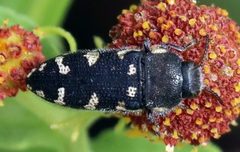
Acmaeodera obtusa is a metallic wood-boring beetle in the Buprestidae, first described by Horn in 1878. The is distributed in North America. Field observations from Texas indicate are active flower visitors, particularly associated with Asteraceae in juniper woodland .
Pronunciation
How to pronounce Acmaeodera obtusa: /æk.miː.oʊˈdɛr.ə ɒbˈtuː.sə/
These audio files are automatically generated. While they are not always 100% accurate, they are a good starting point.
Images
Habitat
Juniper woodland; observed in areas with mixed shortgrass prairie and gypsum-capped clay substrates. have been collected from flowers in open, sunny conditions.
Distribution
Nearctic; North America. Specific records from Texas (Hardeman County) in the southwestern United States.
Seasonality
Active in late June; observed on flowers during midday to afternoon hours.
Diet
feed on flower nectar and pollen. Field records document visitation to Melampodium leucanthum (blackfoot daisy), Tetraneuris acaulis (stemless four-nerve daisy), and Gaillardia pulchella.
Host Associations
- Melampodium leucanthum - FLORAL_HOST collected from flowers in Texas; primary documented during field observations.
- Tetraneuris acaulis - FLORAL_HOST collected from flowers in Texas.
- Gaillardia pulchella - FLORAL_HOST collected from flowers in Texas.
Behavior
are flower visitors. Multiple individuals may occur on the same flowering plant. Activity appears concentrated during warm, sunny midday conditions.
Similar Taxa
- Acmaeodera mixta/immaculata complexSimilar size and flower-visiting ; distinguished by elytral maculation patterns and geographic distribution.
- Acmaeodera ligulataOverlaps in and flower ; A. ligulata typically exhibits more extensive pale elytral markings.