
Texania campestris
(Say, 1823)
Hardwood Heartwood Buprestid
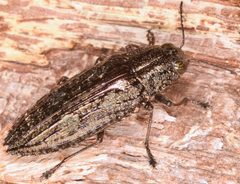
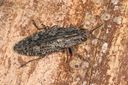
Texania campestris is a of metallic wood-boring beetle in the Buprestidae. The "hardwood heartwood buprestid" reflects its association with hardwood trees and its larval development within heartwood tissue. It is distributed across North America, with records from the United States and Canada. The species is notable for its large size among buprestids and its role as a for predatory fly larvae.
Pronunciation
How to pronounce Texania campestris: //tɛkˈsæni.ə kæmˈpɛstrɪs//
These audio files are automatically generated. While they are not always 100% accurate, they are a good starting point.
Images
Habitat
Associated with dead or dying hardwood trees, particularly in forested and woodland environments. Larvae develop within the heartwood of hardwood stumps and logs.
Distribution
North America; recorded from the United States and Canada (Ontario).
Host Associations
- Platanus occidentalis - larval American sycamore; larvae develop in dead stumps
- Mydus clavatus - prey forlarvae of this mydid fly are on T. campestris larvae
Life Cycle
Larvae are wood-borers that develop within the heartwood of hardwood trees. Mature larvae have been documented in dead sycamore stumps. Specific details on and timing are not documented.
Ecological Role
Larvae contribute to wood decomposition by tunneling through heartwood of dead hardwoods. The serves as prey for predatory insects, including mydid fly larvae.
More Details
Size
Described as a "large buprestid " in rearing records, indicating substantial size relative to other members of the .