
Knowltonia calida
(Knull, 1958)
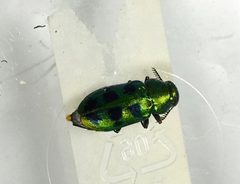
Knowltonia calida is a of metallic wood-boring beetle in the Buprestidae. It is found in Central America and North America. The Knowltonia is characterized by extreme in , with males possessing highly modified or bipectinate antennae while females retain unmodified serrate antennae. This antennal modification is presumed to function in detecting female .
Pronunciation
How to pronounce Knowltonia calida: //nɔlˈtoʊniə ˈkælɪdə//
These audio files are automatically generated. While they are not always 100% accurate, they are a good starting point.
Identification
Distinguished from other buprestid by the extreme in , particularly the bipectinate condition in males. The genus Knowltonia contains four in western North America; K. calida specifically can be distinguished from by subtle morphological differences in antennal structure and body proportions, though detailed diagnostic features require examination of type material or specialized literature. Similar antennal modifications occur in the tribe Xenorhipidini (genera Xenorhipis, Hesperorhipis, Trichinorhipis), but these genera differ in body form, elytral abbreviation, and coxal plate structure.
Images
Habitat
Specific associations are poorly documented. Based on related in the and tribe, likely associated with woody vegetation in arid or semi-arid regions of western North America. Related Knowltonia species and other Xenorhipidini have been reared from various hardwoods including hickory (Carya), walnut (Juglans), and acacia (Acacia).
Distribution
Central America and North America. Specific range details beyond this broad characterization are not available in cited sources.
Behavior
is presumed similar to other Xenorhipidini: adults are short-lived (possibly less than 48 hours), with limited daily activity period. Males are attracted to females via detected by their elaborate . This is inferred from studies on Xenorhipis brendeli and the structural similarity of male antennae across the tribe.
Ecological Role
Larval development in dead or dying woody branches contributes to nutrient cycling in forest and woodland . may function as when visiting flowers, though this has not been documented specifically for this .
Human Relevance
No documented economic importance. Of interest to entomologists and collectors due to rarity and distinctive . The extreme makes males particularly notable specimens.
Similar Taxa
- Knowltonia atrifasciataCongeneric with similar male antennal modifications; distinguished by specific differences in antennal structure and color pattern.
- Xenorhipis brendeliShares extreme in and belongs to same tribe Xenorhipidini; differs in -level characters including body form and elytral abbreviation (less abbreviated in Xenorhipis brendeli).
- Hesperorhipis albofasciatusShares extreme in and abbreviated ; differs in antennal structure (flabellae begin with third antennomere vs. second in Knowltonia) and coxal plate shape.
More Details
Taxonomic History
Originally described as Chrysobothris calida by Knull in 1958, later transferred to Knowltonia. The genus Knowltonia was established to accommodate with distinctive male antennal modifications that were formerly placed in Chrysobothris.
Antennal Evolution
The elaborate male in Knowltonia represent an independent evolutionary origin of this trait within Buprestidae. Similar modifications have evolved independently in Xenorhipidini (tribe level), Mendizabalia (South America), Australorhipis (Australia), and two of Castiarina (Australia). The of this trait suggests strong selection for enhanced detection in mate location.
Sources and further reading
- BugGuide
- Wikipedia
- GBIF taxonomy match
- iNaturalist taxon
- NCBI Taxonomy
- Catalogue of Life
- Meloidae Holdings | Entomology Research Museum
- A new species of Xenorhipus from Baja California | Beetles In The Bush
- Extreme sexual dimorphism in Buprestidae: Xenorhipis hidalgoensis | Beetles In The Bush
- Let’s make a deal! | Beetles In The Bush
- Acanthaceae | Beetles In The Bush