
Xenorhipidini
Cobos, 1986
Genus Guides
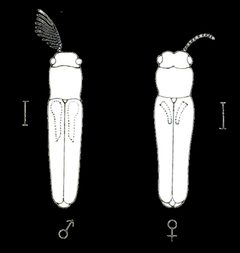
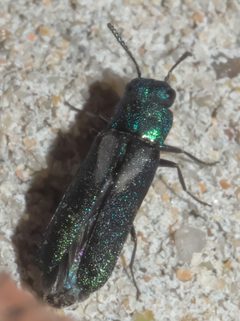
2Xenorhipidini is a small tribe of jewel beetles ( Buprestidae) comprising approximately 8 described across three . The tribe is notable for extreme in antennal structure: males possess highly modified or with expanded segments covered in olfactory sensillae, while females retain unmodified serrate antennae. This modification, unique among non- buprestid tribes, is associated with detection. Members are found in arid and semi-arid regions of North and South America and the West Indies.
Pronunciation
How to pronounce Xenorhipidini: /ˌzɛnəˌraɪˈpɪdɪnaɪ/
These audio files are automatically generated. While they are not always 100% accurate, they are a good starting point.
Identification
Distinguished from all other Buprestidae tribes by the universal presence of highly modified, or male combined with unmodified serrate female antennae—a combination not found elsewhere in the except in scattered unrelated (Knowltonia, Mendizabalia, Australorhipis, Castiarina). Within the tribe, genera separated by elytral length (entire in Trichinorhipis, abbreviated in Xenorhipis and Hesperorhipis), pronotal shape (rounded in Trichinorhipis, quadrate in others), and antennal modification origin (antennomere 2 in Xenorhipis, antennomere 3 in Hesperorhipis).
Images
Habitat
Arid and semi-arid regions including deserts, scrublands, and dry woodlands. Associated with plants in the Carya (hickories), Juglans (walnuts), Acacia, and Simmondsia (jojoba). Larvae develop in dead branches of woody plants.
Distribution
North America (southwestern United States: Arizona, California, Texas, New Mexico; north to Minnesota and New Jersey for X. brendeli), Mexico (Baja California Sur), West Indies, and South America.
Seasonality
activity periods vary by and region; records indicate summer activity (June–August) for multiple species. from reared material documented in August.
Diet
Larvae are wood-borers in dead branches of hardwood trees and shrubs. Documented include Carya (hickory, pecan), Juglans (walnut), Acacia (whitethorn acacia, black acacia, catclaw acacia), and Simmondsia chinensis (jojoba). feeding habits not explicitly documented.
Host Associations
- Carya illinoensis - larval pecan; X. brendeli reared from dead branches
- Carya laciniosa - larval shellbark hickory; X. brendeli reared from dead branches
- Juglans - larval walnut; Hesperorhipis albofasciatus reared from dead branches
- Acacia constricta - larval whitethorn acacia; X. osborni collected on living plant, larval later confirmed
- Acacia rigidula - larval black acacia; X. osborni reared from dead branches
- Acacia greggii - larval catclaw acacia; X. osborni reared from dead branches
- Simmondsia chinensis - larval jojoba; T. knulli breeds in dead branches
Life Cycle
Behavior
Males have been observed attracted in large numbers to caged live females, apparently responding to female-released detected via the specialized antennal sensillae. of some rarely encountered in the field; most specimens obtained through rearing from infested branches.
Ecological Role
Secondary colonizers of dead woody material; larvae contribute to decomposition of dead branches. Role in nutrient cycling in arid woodland . Potential prey for spiders and other .
Human Relevance
Of interest to coleopterists due to distinctive and rarity of some . No documented economic importance; not considered a pest of living trees. Occasionally used in trapping studies (X. brendeli captured in panel traps with leaf alcohol and Verbenone lures).
Similar Taxa
- Other Buprestidae tribesXenorhipidini uniquely distinguished by universal / male with -detecting sensillae; other tribes have serrate or pectinate male antennae without such extreme modification
- Knowltonia with independently evolved biflabellate male , but not placed in Xenorhipidini; distinguished by different body form and non-abbreviated
- Mendizabalia, Australorhipis, CastiarinaScattered with convergent male antennal modifications, but phylogenetically unrelated and geographically separated (South America, Australia); distinguished by overall and distribution
More Details
Taxonomic revision
The tribe is currently under revision by Dr. Charles Bellamy (California Department of Food and Agriculture). Generic boundaries, particularly between Xenorhipis and Hesperorhipis, may be subject to change given intermediate character states in some (e.g., X. bajacalifornica).
Subtribal classification
Trichinorhipis placed in separate subtribe Trichinorhipidina due to distinctive characters: entire , rounded pronotum, and unique antennal organization. Hesperorhipis and Xenorhipis placed in subtribe Xenorhipidina.
Collection rarity
Many known from few specimens; some described species known only from type material. Rarity in collections reflects genuine scarcity, cryptic habits, and dependence on specific plants in restricted rather than collector neglect.