
Agrilus sulcicollis
Lacordaire in Boisduval & Lacordaire, 1835
European oak borer
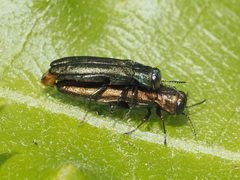
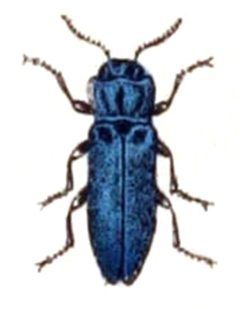
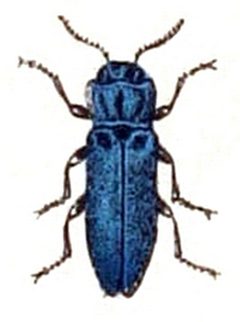
Agrilus sulcicollis, commonly known as the European oak borer, is a metallic wood-boring beetle in the Buprestidae. Native to Europe and Northern Asia, it has been introduced to North America, with confirmed records in southern Ontario, Canada, and the northeastern United States. The is associated with oak trees and is one of nine non-native Agrilus species established in North America.
Pronunciation
How to pronounce Agrilus sulcicollis: /ˈæɡrɪləs ˌsʌlsɪˈkɒlɪs/
These audio files are automatically generated. While they are not always 100% accurate, they are a good starting point.
Identification
Agrilus sulcicollis can be diagnosed among North American Agrilus by morphological characters detailed in taxonomic literature. It is illustrated in Jendek & Grebennikov (2009) to facilitate recognition. The species belongs to a group of Agrilus associated with oak , though specific distinguishing features from native North American oak-associated species require examination of detailed morphological characters.
Images
Habitat
Oak woodlands and forests. Associated with oak trees (Quercus spp.) as larval .
Distribution
Native to Europe (widespread across most countries), Northern Asia (excluding China), and parts of North Africa (Algeria, Morocco, Tunisia). Introduced to North America with confirmed records in southern Ontario, Canada, and Michigan and New York, USA.
Host Associations
- Quercus spp. - larval Primary ; implied by 'European oak borer'
- Carpinus betulus - larval Hornbeam; secondary
- Castanea spp. - larval Chestnut; secondary
Ecological Role
Wood-boring whose larvae tunnel in living or recently dead woody plants. As an introduced in North America, it represents a potential forest pest, though its impact relative to other Agrilus species (such as A. planipennis, the emerald ash borer) appears limited based on current records.
Human Relevance
Agrilus sulcicollis is one of nine non-native Agrilus established in North America. While it has been detected in North America, it has not achieved the notoriety of A. planipennis (emerald ash borer) as a major forest pest. Monitoring and accurate identification are important for tracking its spread and potential impact on oak-dominated forests.
Similar Taxa
- Agrilus planipennisBoth are Agrilus in North America, but A. planipennis attacks ash (Fraxinus) rather than oak and has caused far more extensive damage
- Other North American native Agrilus speciesMany native Agrilus occur on oak; accurate identification requires examination of morphological details and reference to diagnostic literature
- Agrilus cuprescens, A. cyanescens, A. derasofasciatus, A. hyperici, A. pilosovittatus, A. sinuatus, A. subrobustusThese are the other eight non-native Agrilus established in North America, all of which require careful morphological examination to distinguish from A. sulcicollis
More Details
Taxonomic note
Agrilus sulcicollis was described by Lacordaire in 1835. The Agrilus is one of the largest genera in the animal kingdom with nearly 4,000 described .
Invasion history
First reported in North America from southern Ontario, Canada. The has since been recorded in Michigan and New York, USA. Its introduction and date are not well documented in the available literature.
Identification resources
Jendek & Grebennikov (2009) provide illustrations and diagnostic information to distinguish this from other North American Agrilus.
Sources and further reading
- BugGuide
- Wikipedia
- GBIF taxonomy match
- iNaturalist taxon
- NCBI Taxonomy
- Catalogue of Life
- Protecting American Coffee, Wine and Baseball Bats | Bug Squad
- Lycidae | Beetles In The Bush
- Two new species of Agrilus from Mexico | Beetles In The Bush
- Agrilus fuscipennis on Persimmon | Beetles In The Bush
- GBCT Beetle #2: Agrilus walsinghami | Beetles In The Bush
- A flower visiting jewel beetle that is not an Acmaeodera | Beetles In The Bush
- Agrilus sulcicollis . [Distribution map].
- Agrilus sulcicollis (Coleoptera: Buprestidae), a new alien species in North America