
Agrilus malvastri
Fisher, 1928
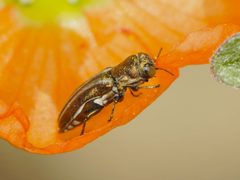
Agrilus malvastri is a metallic wood-boring beetle in the Buprestidae, described by Fisher in 1928. It is one of the few North American Agrilus documented as routinely visiting flowers, specifically those of Sphaeralcea (globemallows). The species occurs in Central America and North America, with records from the southwestern United States including New Mexico, Utah, and Arizona. Unlike most Agrilus species, which are associated with woody plants, A. malvastri appears to be associated with herbaceous plants in the family Malvaceae.
Pronunciation
How to pronounce Agrilus malvastri: /ˈæɡrɪləs mælˈvæstri/
These audio files are automatically generated. While they are not always 100% accurate, they are a good starting point.
Identification
Agrilus malvastri can be distinguished from other North American Agrilus by its consistent association with Sphaeralcea flowers. The is small and metallic, typical of the , but field identification relies heavily on plant association. It may be confused with other small Agrilus species found in similar , but its presence on globemallow flowers is diagnostic. The species is smaller than most Acmaeodera species with which it co-occurs on flowers, and lacks the bold yellow or red elytral patterns characteristic of that genus.
Images
Habitat
Found in arid and semi-arid regions including sand dune , pinyon/oak/juniper woodlands, and grassland-chaparral transition zones. Associated with areas where Sphaeralcea (scarlet globemallow, small-leaved globemallow, desert globemallow) occur. Habitats range from low elevation sandhill scrub to mid-elevation woodlands.
Distribution
Central America and North America. Documented from the southwestern United States including New Mexico (Mills Rim, Harding County; Mescalero Sands; Bottomless Lakes area), Utah (Kane County, San Juan County), and Arizona (Coconino County). The GBIF record indicating presence in Alberta, Canada appears anomalous and requires verification.
Seasonality
have been observed from mid-May through June. Activity appears to peak in late spring, with records from May 14–25 in New Mexico and early June in Utah and Arizona. Activity is likely tied to flowering of Sphaeralcea plants.
Diet
feed on flowers of Sphaeralcea (globemallows), specifically observed on Sphaeralcea coccinea (scarlet globemallow), Sphaeralcea parvifolia (small-leaved globemallow), and Sphaeralcea ambigua (desert globemallow). Larval diet unconfirmed; Sphaeralcea is suspected as the larval but has not been definitively established through rearing.
Host Associations
- Sphaeralcea coccinea - food sourcescarlet globemallow; primary flower documented in field observations
- Sphaeralcea parvifolia - food sourcesmall-leaved globemallow; documented in Utah and Arizona
- Sphaeralcea ambigua - food sourcedesert globemallow; documented in Arizona
Behavior
are and actively visit flowers, where they have been observed feeding on floral tissues. They are not strong fliers and are typically found by visual inspection or sweeping of flowers. Adults appear to be relatively sedentary on host plants once located. The exhibits a 'flower-visiting' unusual for the Agrilus, which is predominantly associated with woody vegetation.
Ecological Role
function as or floral visitors in arid , contributing to pollination networks of Sphaeralcea . The species occupies a typically filled by Acmaeodera species in western North American buprestid . Larval role unknown but likely involves herbivory of living plant tissues if Sphaeralcea is confirmed as the larval .
Human Relevance
No direct economic importance documented. Of interest to entomologists studying plant shifts in Buprestidae, as one of few Agrilus associated with herbaceous Malvaceae rather than woody plants. May serve as an for intact arid grassland and woodland supporting native globemallow .
Similar Taxa
- Acmaeodera speciesCo-occur on flowers in same ; Acmaeodera are generally larger with bold yellow/red elytral patterns and more robust build
- Agrilus muticusAnother flower-visiting Agrilus, but associated exclusively with Callirhoe involucrata (winecup, Malvaceae) in Texas, Oklahoma, and Kansas; or parapatric distribution with different plant
- Agrilus blandusFlower-visiting Agrilus associated with Eriogonum (Polygonaceae); different plant and typically more western distribution
More Details
Taxonomic history
Described by W.S. Fisher in 1928 as part of his revision of North American Agrilus. The epithet 'malvastri' references its association with plants in the Malvaceae (formerly Malvales). Fisher noted the species from specimens collected on Sphaeralcea, establishing the plant association that remains the primary field character for identification.
Field detection challenges
The is easily overlooked due to its small size and similarity to other small beetles in Sphaeralcea flowers. Field observers typically detect it only through systematic sweeping or close visual inspection of flowers. Single specimens are often found after extensive searching, suggesting low or cryptic even when present.
Research needs
Larval and remain unconfirmed; rearing from Sphaeralcea stems or roots is needed to establish the complete . The Alberta, Canada distribution record requires verification as it falls well outside the documented range and may represent a data entry error or misidentification.