
Agrilus cyanescens
(Ratzeburg, 1837)
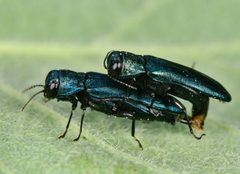
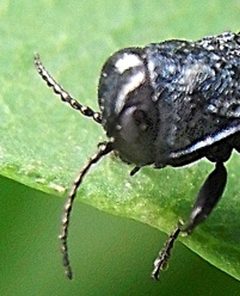
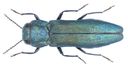
Agrilus cyanescens is a metallic wood-boring beetle in the Buprestidae. The is native to Europe and Northern Asia (excluding China) and has been introduced to North America, where it is now considered . It has been newly recorded in Connecticut and other eastern states. Two are recognized: A. c. cyanescens and A. c. johanidesi.
Pronunciation
How to pronounce Agrilus cyanescens: /ˈæɡrɪləs saɪəˈnɛsɛnz/
These audio files are automatically generated. While they are not always 100% accurate, they are a good starting point.
Images
Habitat
Ash stands (Fraxinus L., Oleaceae) in the Great Lakes region of the United States. The is associated with ash foliage for activity.
Distribution
Native to Europe and Northern Asia (excluding China). Introduced and established in North America, with new distributional records in Connecticut and other eastern states. GBIF records indicate presence across multiple biogeographic regions including Palearctic, Nearctic, and others.
Host Associations
- Fraxinus L. - association activity observed in ash stands; foliage used for mate-finding . relationship inferred from study location and model placement on ash foliage.
Behavior
Males locate females via visually guided aerial approach from up to 1 m above, similar to Agrilus planipennis. During descent, males land directly on female models. After landing, males reject models lacking female cuticular lipids, indicating post-landing chemical evaluation of mates.
Human Relevance
in North America, with expanding distribution in eastern United States.
Similar Taxa
- Agrilus subcinctusSimilar mate-finding including visual aerial orientation from up to 1 m and use of contact . However, A. subcinctus males land more often on leaf surfaces supporting models rather than directly on models, and perform precopulatory pounce behavior after antennal assessment of surface chemical cues.
- Agrilus planipennisSimilar visually guided aerial approach for mate location.
More Details
Mating behavior details
Field studies using dead specimens affixed to ash foliage demonstrated that males use both visual and chemical cues in mate recognition. Visual orientation occurs from up to 1 m distance, followed by direct landing. Post-landing rejection of washed models (lacking cuticular lipids) confirms that contact mediate copulation after initial visual location.
Subspecies
Two are recognized: Agrilus cyanescens cyanescens (Ratzeburg, 1837) and Agrilus cyanescens johanidesi Niehuis, 1999.
Sources and further reading
- BugGuide
- Wikipedia
- GBIF taxonomy match
- iNaturalist taxon
- NCBI Taxonomy
- Catalogue of Life
- Agrilus fuscipennis on Persimmon | Beetles In The Bush
- Two new species of Agrilus from Mexico | Beetles In The Bush
- GBCT Beetle #2: Agrilus walsinghami | Beetles In The Bush
- North America’s Most Beautiful Agrilus Jewel Beetle | Beetles In The Bush
- A flower visiting jewel beetle that is not an Acmaeodera | Beetles In The Bush
- Josef Knull was wrong! | Beetles In The Bush
- Field investigation of mating behaviour of Agrilus cyanescens and Agrilus subcinctus
- New Distributional Records of Invasive Coleoptera Found in Connecticut and Other Eastern States: Agrilus cyanescens (Ratzeburg) (Buprestidae), Lilioceris lilii (Scopoli), and Pyrrhalta Viburni (Paykull) (Chrysomelidae)