
Agrilus subcinctus
Gory, 1841
Native Ash Borer
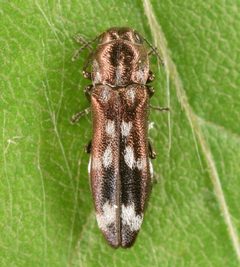
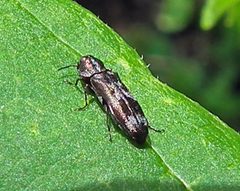
Agrilus subcinctus, commonly known as the native ash borer, is a North American jewel beetle (Buprestidae) that develops in ash (Fraxinus) trees. Unlike the emerald ash borer (A. planipennis), this is restricted to dead ash twigs for larval development. are active from late May through mid-August, with peak in June. The species serves as for multiple hymenopteran and has been studied for its distinct mating , which involves visual aerial orientation followed by contact chemical signal evaluation.
Pronunciation
How to pronounce Agrilus subcinctus: /ˈæɡrɪləs sʌbˈsɪŋktəs/
These audio files are automatically generated. While they are not always 100% accurate, they are a good starting point.
Identification
Distinguished from the emerald ash borer (Agrilus planipennis) by larval : fourth instar larvae similar in size to second instar EAB; abdominal segment shape differs; pronotal groove and urogomphi distinct from EAB. captured on yellow sticky cards. Specific adult coloration and body form not described in available sources.
Images
Habitat
Dead ash twigs (Fraxinus); and stages found exclusively on dead ash twigs, not living stems or branches. Associated with ash stands in the Great Lakes region of the United States.
Distribution
Native to North America; recorded from the Great Lakes region (United States), southern Michigan, Ontario (Canada), and Vermont. GBIF records indicate presence in the Nearctic region.
Seasonality
fly from late May through mid-August, with peak activity in June. laying begins late May to early June.
Host Associations
- Fraxinus spp. - larval dead ash twigs only; and stages restricted to dead twigs
Life Cycle
Four larval instars; period late May through mid-August; laying begins late May to early June; eggs smaller than those of emerald ash borer.
Behavior
Males locate females via visually guided aerial approach from up to 1 m above females, similar to Agrilus planipennis. Upon landing, males land significantly more often on the leaf surface supporting a female model rather than directly on the model itself—a distinct from A. cyanescens, which lands directly on female models. Males perform precopulatory pounce behavior after assessing surface chemical cues with their . Contact mediate subsequent copulation behavior after physical contact.
Ecological Role
Native ash borer; serves as for multiple hymenopteran including representatives of Encyrtidae, Braconidae, Eurytomidae, Eulophidae, Eupelmidae, and Pteromalidae. Restricted to dead wood, thus not a primary tree mortality agent.
Human Relevance
Studied primarily for comparison with the emerald ash borer (Agrilus planipennis) to aid in identification and management of the pest . Native status means it does not cause significant economic damage to living trees.
Similar Taxa
- Agrilus planipennisBoth develop in ash (Fraxinus); distinguished by A. subcinctus restriction to dead twigs versus EAB of live stems and branches; larval differs in abdominal segment shape, pronotal groove, and urogomphi; A. subcinctus are smaller.
- Agrilus cyanescensBoth studied together for mating ; both use visual aerial orientation to locate females up to 1 m away; distinguished by landing behavior—A. subcinctus males land on leaf surface near females while A. cyanescens lands directly on female models.
Sources and further reading
- BugGuide
- Wikipedia
- GBIF taxonomy match
- iNaturalist taxon
- NCBI Taxonomy
- Catalogue of Life
- Two new species of Agrilus from Mexico | Beetles In The Bush
- Agrilus fuscipennis on Persimmon | Beetles In The Bush
- GBCT Beetle #2: Agrilus walsinghami | Beetles In The Bush
- North America’s Most Beautiful Agrilus Jewel Beetle | Beetles In The Bush
- A flower visiting jewel beetle that is not an Acmaeodera | Beetles In The Bush
- Josef Knull was wrong! | Beetles In The Bush
- Field investigation of mating behaviour of Agrilus cyanescens and Agrilus subcinctus
- Biology and Larval Morphology of Agrilus subcinctus (Coleoptera: Buprestidae), with Comparisons to the Emerald Ash Borer, Agrilus planipennis