
Agrilus amelanchieri
Knull, 1944
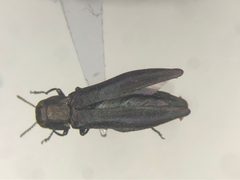
Agrilus amelanchieri is a metallic wood-boring beetle ( Buprestidae) described by Knull in 1944. The belongs to the hyperdiverse Agrilus, which contains nearly 4,000 described species and may be the largest genus in the animal kingdom. Based on the specific epithet and comparison with such as A. vittaticollis, this species is likely associated with serviceberry (Amelanchier) as a larval . Like other members of the genus, are probably found on foliage of their host plants. The species occurs in North America, with records from Ontario and Québec in Canada.
Pronunciation
How to pronounce Agrilus amelanchieri: /ˈæɡrɪləs ˌæməˈlæŋkiˌɛraɪ/
These audio files are automatically generated. While they are not always 100% accurate, they are a good starting point.
Identification
Specific diagnostic features for A. amelanchieri are not documented in the provided sources. Within the Agrilus, identification typically requires examination of male genitalia due to the morphological similarity of many . The species name suggests association with Amelanchier (serviceberry), which may aid in field recognition when found on this . Comparison with the similar A. vittaticollis (also associated with Amelanchier) would require detailed morphological study.
Images
Habitat
Likely associated with woodland and forest edge where serviceberry (Amelanchier) occurs. Based on , larvae probably develop in branches or stems of living or recently dead plants.
Distribution
North America. Documented from Ontario and Québec, Canada. The GBIF match indicates broader distribution records including , though specific locality data beyond Canada is not confirmed in available sources.
Seasonality
activity period not documented in available sources. Most Agrilus are active during spring and early summer, though some western species associated with Asteraceae exhibit late summer activity.
Host Associations
- Amelanchier - probable larval Inferred from specific epithet; confirmed for A. vittaticollis
Life Cycle
Behavior
likely occur on foliage of plants, as is typical for the . Not known to visit flowers.
Ecological Role
Larvae function as primary consumers, tunneling in woody plant tissue and contributing to nutrient cycling. Their role in forest is generally minor except when occur.
Human Relevance
No documented economic importance. Not known to be a significant pest of serviceberry or other cultivated plants.
Similar Taxa
- Agrilus vittaticollisAlso associated with Amelanchier (serviceberry); larger (12–14 mm) with vivid red pronotum and black ; may be distinguished by coloration and size
- Other Agrilus speciesHyperdiverse with nearly 3,000 described in North America; many morphologically similar and require genitalia examination for definitive identification
More Details
Etymology
The specific epithet 'amelanchieri' derives from Amelanchier, the of serviceberry, indicating the probable larval association.
Taxonomic context
Agrilus is perhaps the largest in the animal kingdom, with nearly 4,000 described worldwide. The genus is characterized by small size, typically subdued metallic coloration compared to other Buprestidae, and primarily woody plant associations. Species limits are often difficult to define, with many distinguishable only by male genitalia.
Sources and further reading
- BugGuide
- Wikipedia
- GBIF taxonomy match
- iNaturalist taxon
- Catalogue of Life
- longhorned beetles | Beetles In The Bush | Page 10
- Two new species of Agrilus from Mexico | Beetles In The Bush
- Agrilus fuscipennis on Persimmon | Beetles In The Bush
- GBCT Beetle #2: Agrilus walsinghami | Beetles In The Bush
- A flower visiting jewel beetle that is not an Acmaeodera | Beetles In The Bush